
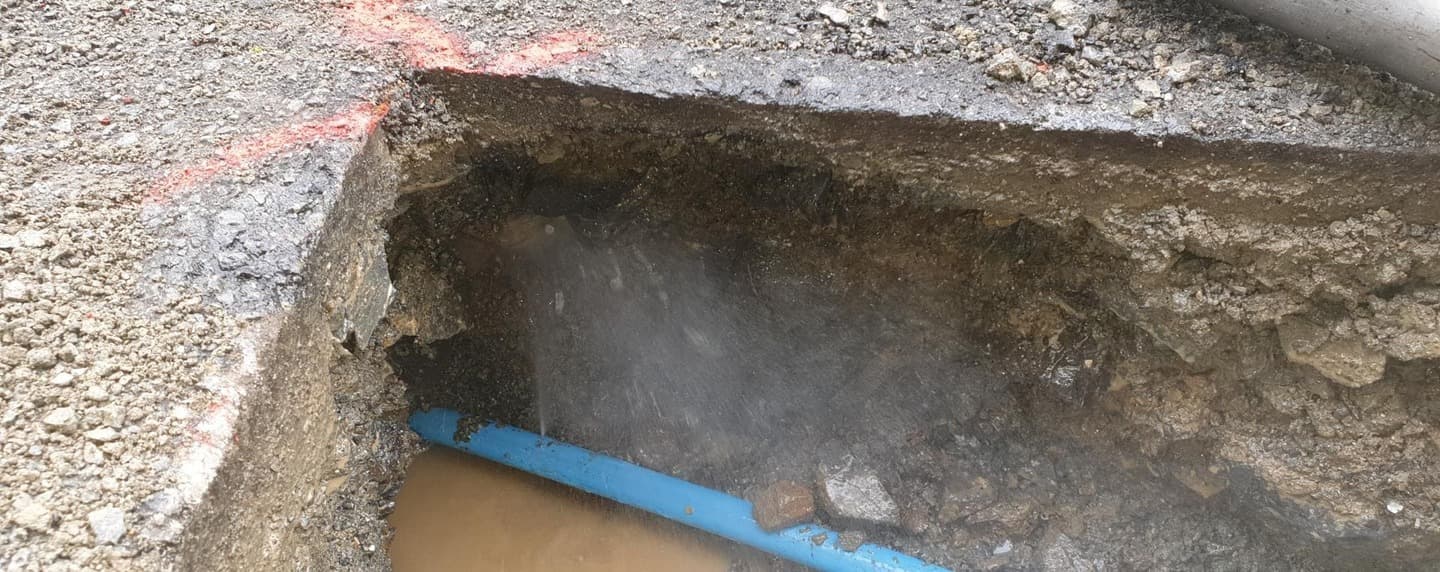
Leak Detection in Waiuku
Local leak detection for Waiuku and the wider Franklin & Pukekohe area
Since 2015Own locators, hydro-vac & diggersAuckland · Franklin · North Waikato
Leak detection and service detection jobs can start from $300 +GST. Every job is different, so call 0800 779 588 and we’ll talk through your situation and give you an estimate.
Leak Detection for Waiuku properties, sites and farms
Waiuku is one of the nearest towns to our Waiau Pa yard, so it is a short, low-cost call-out. Leak work here splits two ways: Watercare-supplied homes and businesses in town, and bore or tank-fed properties on the lifestyle blocks and farms around it, where a leak on a long private line can run a pump flat and empty a tank overnight. The sandy coastal ground near the harbour drains fast and hides leaks well, so acoustic detection and tracing do the finding before a spade touches the ground.
Typical leak detection jobs in Waiuku
- Finding leaks on bore-fed lines that are running pumps continuously on lifestyle blocks
- Acoustic leak detection on commercial premises along Waiuku's main streets
- Tracing and repairing stock-water lines leaking somewhere across a paddock
Leak Detection, in short
Water from a broken pipe rarely surfaces where the break is. We find the exact spot with acoustic listening gear, leak correlators, pipe tracing and, where it helps, ground penetrating radar and thermal imaging, so the dig is small and in the right place. Then the same crew excavates with our own digger or hydro-vac truck, repairs the pipe and reinstates the lawn, driveway or concrete. We work on everything from a single house connection to retirement villages, schools, farms and industrial sites, and we test afterwards so you can see the loss has stopped.
Full details: Underground Leak Detection & Repair →Working underground in Waiuku
Waiuku sits at the head of a long inlet of the Manukau Harbour, with the Glenbrook steel mill a few kilometres away and a wide spread of rural lifestyle blocks around the town. Ground conditions range from sandy coastal soils near the water to heavier clay further inland.
The town itself has a mix of older housing on established streets and newer homes on the edges, supplied with water through Watercare. Beyond the town boundary most properties rely on bores, roof tanks or long private lines, and it is common to find pipework laid decades ago with no record of its route.
Being on the same side of the Manukau as our Waiau Pa base, Waiuku is one of our closest service areas. We cover everything from locating services before new fences and sheds go in to tracing and repairing leaks on farm and lifestyle block supplies.
When Waiuku’s homes were built, and what that means for leaks
The age of a house tells us what pipe and cable to expect underneath it before we arrive.
Before 1960
Waiuku began as a trading port in 1851 with the Kentish Hotel at its centre. After a fire in 1916 the centre had to be rebuilt in brick or masonry, and the older houses sit close around it; the town became a borough in 1955.
1960s to 1980s
The Glenbrook steel mill opened in 1968 a few kilometres away and Waiuku became home to many of its workers. The bulk of the town's housing, the plain three-bedroom homes on the streets behind the centre, went up in these two decades.
1985 to 2000
Waiuku joined Franklin District in 1989 and grew slowly, with infill on larger old sections and lifestyle blocks along the roads toward Glenbrook and up the Āwhitu Peninsula.
Since 2000
The population rose from 7,458 in 2006 to 9,531 in 2023, modest next to Pukekohe. New homes sit on the edges, and Watercare has installed a fourth bore at 11 Cornwall Road, not yet in service in the 2024 to 2025 year.
What Waiuku’s water pipes are made of, and how they fail
The brick main street and the streets around it are old enough for galvanised laterals and cast iron or early asbestos-cement mains. The mill-era estates from the 1960s and 70s carry asbestos-cement mains and copper or galvanised laterals, and Waiuku has a twist the other Franklin towns do not: the town water comes from the Kaawa shell aquifer and Watercare rates it moderately hard, at 100 to 120 milligrams a litre. That hardness scales up the inside of old galvanised and copper pipe, so a 1970s lateral here can be half-blocked as well as pinholed, and low pressure at the kitchen tap is as common a complaint as a wet lawn.
Houses from the late 1980s and 90s may still have Dux Quest polybutylene, which fails at the fittings. On the lifestyle blocks the pipe is alkathene from a bore or tank, laid by whoever owned the place at the time, with no tracer wire and no plan. The sandy ground around the harbour swallows the water from a break, so a leak on a bore line often shows only as a pump that never stops. Radar does well in dry sand, which helps us find those plastic lines before anyone fences or builds over them.
Why leaks are hard to find in Waiuku’s dune sand
Waiuku sits at the isthmus of the Āwhitu Peninsula, which is a dune system built over the last two million years from black Taranaki ironsand mixed with quartz and pumice sand carried down the Waikato River. The eastern side of the peninsula, where the town is, slopes gently to low-lying swampy ground along the Waiuku River and the harbour edge. So the ground changes within a few streets: free-draining sand on the rises, soft wet ground and high water tables along the inlet.
Sand drains fast, which hides leaks and makes trench walls run, so we shore or use the hydro-vac to keep a hole open. It is also good radar ground when dry; close to the harbour the wet, slightly salty sand absorbs the signal and we rely more on tracing and potholing. Under the town the Kaawa shell aquifer supplies Watercare's three bores at Waiuku Road, Victoria Avenue and the corner of Cornwall and Kitchener Roads, with the Cornwall and Victoria bores shallower than the Waiuku Road one and more sensitive to a dry year. Watercare's monitoring has found no sign of saline intrusion in the aquifer.
Who owns the pipes in Waiuku
Which network a service belongs to decides who fixes it, who you call first and whose plans a beforeUdig request returns.
Water supply
Watercare supplies the town from three bores into the Kaawa shell aquifer, treated at small plants on Waiuku Road, Victoria Avenue and Cornwall Road; the water is moderately hard. Watercare's side ends at the outlet of the meter fitting closest to your private pipe.
Wastewater
Watercare runs Waiuku's sewers. Beyond the town boundary, and across most of the Āwhitu Peninsula, properties are on septic tanks and soak pits, which radar finds more often than any plan does.
Electricity
Counties Energy owns the lines across Waiuku, Glenbrook and the whole peninsula, as part of a network that runs coast to coast from southern Papakura to Mercer.
Gas
Waiuku is reticulated for natural gas: the industry gas-gate register lists a Waiuku gate commissioned on 7 June 2019. Request the gas plans through beforeUdig rather than assuming the berm is empty.
Fibre and phone
Chorus owns the copper and the fibre, and the Waiuku UFB fibre build is listed as complete.
beforeUdig plans
Expect Counties Energy, Watercare, Chorus and the gas distributor for the road frontage. The plans will not show bore lines, septic systems or stock-water pipe, so on a rural block the beforeUdig result is the start of the job, not the end.
Jobs we have done here
Recent work around Waiuku
In Tony's words, from the Utility Works Facebook page. Clients unnamed, as they are there.
“A completed service locate for a culvert renewal at Glenbrook Beach for one of our regular clients.”
Underground Service Locating · WaiukuTony Eggleton · May 2023
One crew for Waiuku: find it, dig it, fix it.
Waiuku is about 20 minutes from our yard at Waiau Pa, along the same side of the harbour, so travel adds little and a Waiuku call-out usually fits into the day it comes in.
Get a free quoteNeed leak detection in Waiuku? Call us for a free, no-obligation quote.
Free, no-obligation quote · Mon–Fri 7am–5pm · Auckland, Franklin & North Waikato
Google reviews
What customers say
“Prompt service & fair pricing. Tony and his team — sharp eye for detail and out of the box problem solving paired with a high standard of workmanship.”
Richard La Trobe · Google · October 2026
“Really happy with the work to install our underground services. Highly recommend.”
Sarah Walworth · Google · October 2026
“The only company we trust… reliable, cost effective, and honest service from A to Z. 100% confidence in this company.”
Darrel Assink · Google · September 2026
Our Projects
1–2 of 4
South Auckland
Retirement Village Water Leak Detection & Repair
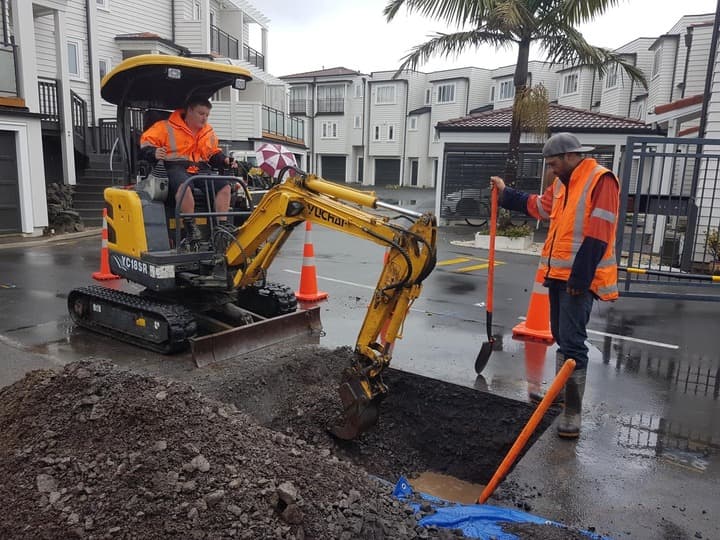
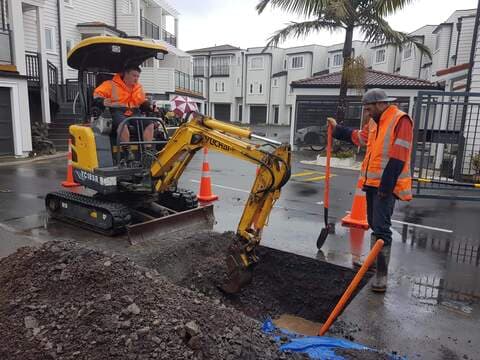
A large retirement village of 58 units in South Auckland had been experiencing underground water loss. Utility Works conducted system loss testing, system mapping, mark-out and CCTV/sonde pinpointing of joint and tapping band positions, isolation point installation, followed by acoustic and infrared detection works. Once leak positions were located, we implemented strategic excavation and pipe repairs, followed by ground reinstatement and site clean-up. This successful project resulted in the accurate locating and repair of five leak positions, and provided substantial water savings to the client.
Read the case study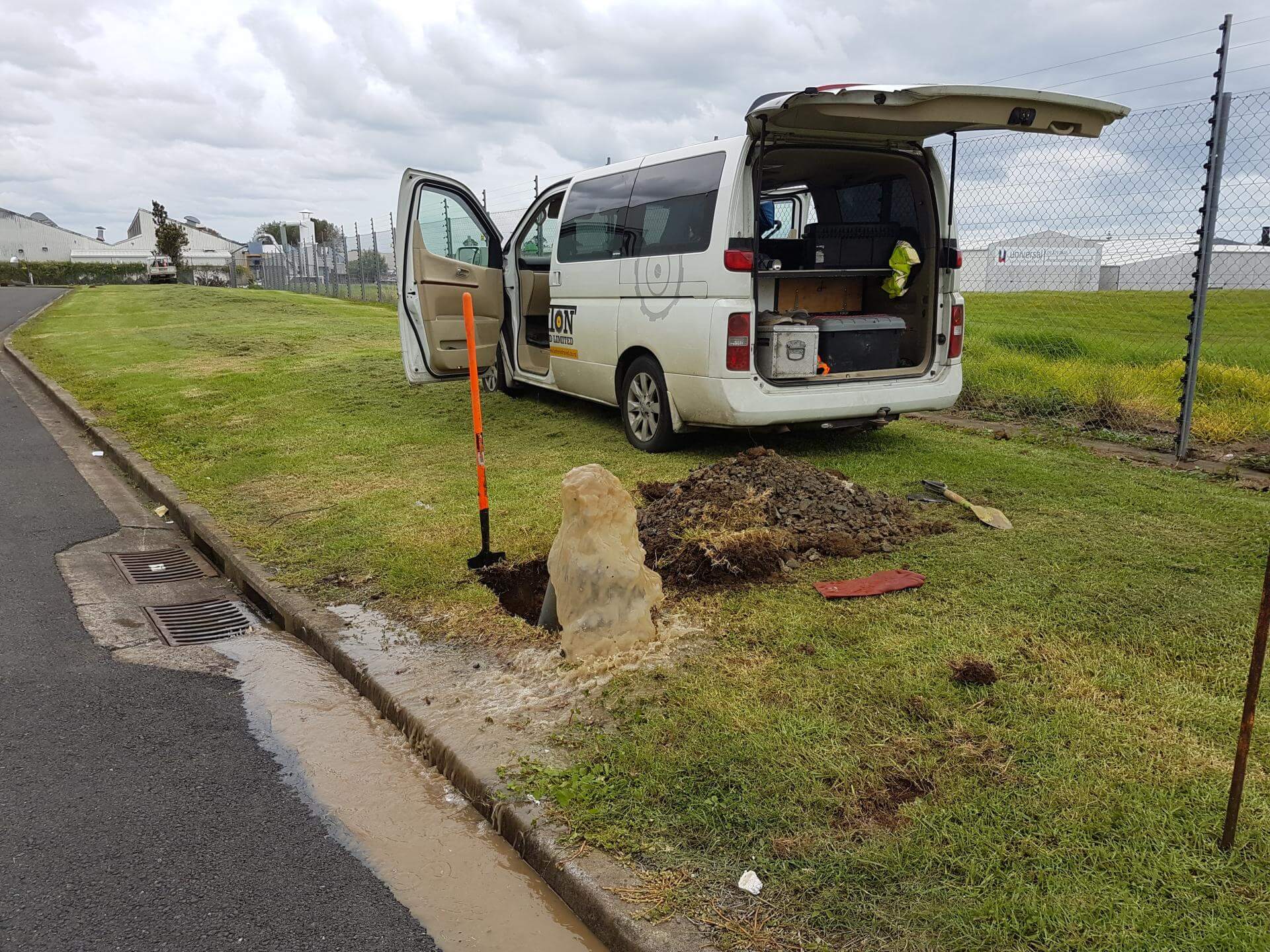
East Tāmaki, Auckland
Industrial Property Water Loss Investigation
A large, 14-hectare industrial property in East Tāmaki was experiencing a high-volume water-loss issue. The busy site was losing in excess of 170 L/min and substantial works had already been undertaken to attempt locating the leak before Utility Works was engaged. We undertook a strategic approach to the investigation including a full site audit and partial mapping of the 180mm mains and isolation testing, followed by IR, GPR, and acoustic works which enabled us to pinpoint the leak, have the position excavated, and the leak repaired overnight.
Read the case studyLeak Detection in Waiuku: your questions
Who is responsible for a leak at the water meter in Waiuku?
Why does my bore pump near Waiuku run all night?
Does Waiuku's hard water damage pipes?
Ready when you are.
Tell us what you’re seeing or what you’re planning. You’ll get a straight answer, a free quote and one crew that does the whole job.
Mon–Fri 7am–5pm · Waiau Pa, South Auckland · Auckland, Franklin & North Waikato