
Articles & Advice · 2 April 2026
Before You Dig in NZ: What beforeUdig Gives You and What It Doesn't
Everyone planning to dig in New Zealand is told to lodge a beforeUdig enquiry first, and they should. But the plans that come back are a starting point, not a mark-out. This guide explains what beforeUdig actually provides, where its plans fall short on real sites across Auckland and the Waikato, what professional service locating adds, and the sequence that keeps you, your crew and your budget out of trouble.
Striking a buried service is the most expensive thing that can happen on a small excavation. A severed fibre cable can put a street offline and attract a repair bill from the network owner. A cut low-voltage cable can kill the person holding the shovel. A broken water main floods the trench and your neighbour's garage. Most strikes we are called to afterwards had one thing in common: someone had the beforeUdig plans in the truck and assumed that was the job done. It is the first step, not the last.
What beforeUdig is
beforeUdig is New Zealand's free referral service for anyone planning excavation. You lodge an enquiry online or through the app, draw the area you intend to dig, and the service passes your request to every registered asset owner with infrastructure nearby. Each owner then sends you its own plans and conditions, usually by email. In our area that typically includes Watercare, Vector, Counties Energy, WEL Networks, Powerco, Chorus, Tuatahi First Fibre, Firstgas, Auckland Transport and the relevant district council. Responses arrive separately, some within minutes, some in two or three working days.
Lodging the enquiry is not optional in any practical sense. Under the Health and Safety at Work Act 2015, anyone running an excavation has a duty to identify and manage the risk of buried services, and WorkSafe's guidance on underground services treats obtaining plans as the minimum. Road controlling authorities will not issue a corridor access request without a current enquiry number, and if you damage a network asset without having lodged one, you will have a very hard conversation with the asset owner about who pays.
What the plans give you
- The approximate alignment of each owner's assets in and near your area: cables, water and wastewater mains, gas mains, fibre and copper.
- Each owner's conditions for working near its assets. These matter. Most prohibit mechanical excavation within a set distance of the asset, typically half a metre to a metre either side, and require hand digging or hydro excavation inside that zone. Some, such as high-pressure gas and high-voltage cable owners, require their own representative on site before you dig.
- An enquiry number and date, which is your evidence of due diligence and your ticket to a corridor access request.
- A validity window. Most asset owners treat plans as current for a limited period, often about a month, because networks change. Dig next quarter and you lodge again.
What the plans do not give you
This is the part that gets people hurt. beforeUdig plans are records, not a survey of the ground.
- No depth. Plans almost never state depth, and a note such as "nominal cover 600 mm" is a design intent from decades ago, not a measurement. Roads get regraded, berms get built up, driveways get cut down.
- Not a precise position. Plans are schematic. A line drawn in the berm might be anywhere across it. Alignments were often recorded from the kerb or boundary at the time of installation, and both have moved since on many Auckland streets.
- Only the public side. Asset owners record their network up to the point of supply at your boundary. The power cable from the pillar to the house, the water lateral from the meter, the fibre lead-in, the irrigation, the farm water line, the old power to the pump shed: none of it is on any plan.
- Only registered owners. Private networks, body corporate reticulation, school and hospital campuses, farm schemes and many older council assets are not in the system. A site can come back "no assets" and still be full of pipe.
- Abandoned and undocumented services. Decommissioned mains are often left in the ground and dropped from plans. Services relaid during renovations rarely get recorded.
- No identification on the ground. A plan tells you something is roughly there. It does not tell you which of three ducts in the trench is live, or whether the water main is the 100 mm asbestos cement pipe from 1965 or the PE replacement laid beside it.
In the Australian and New Zealand standard for classifying subsurface utility information, AS 5488, records like these sit at the lowest quality level, QL-D. They are the right place to start and the wrong place to stop.
What professional service locating adds
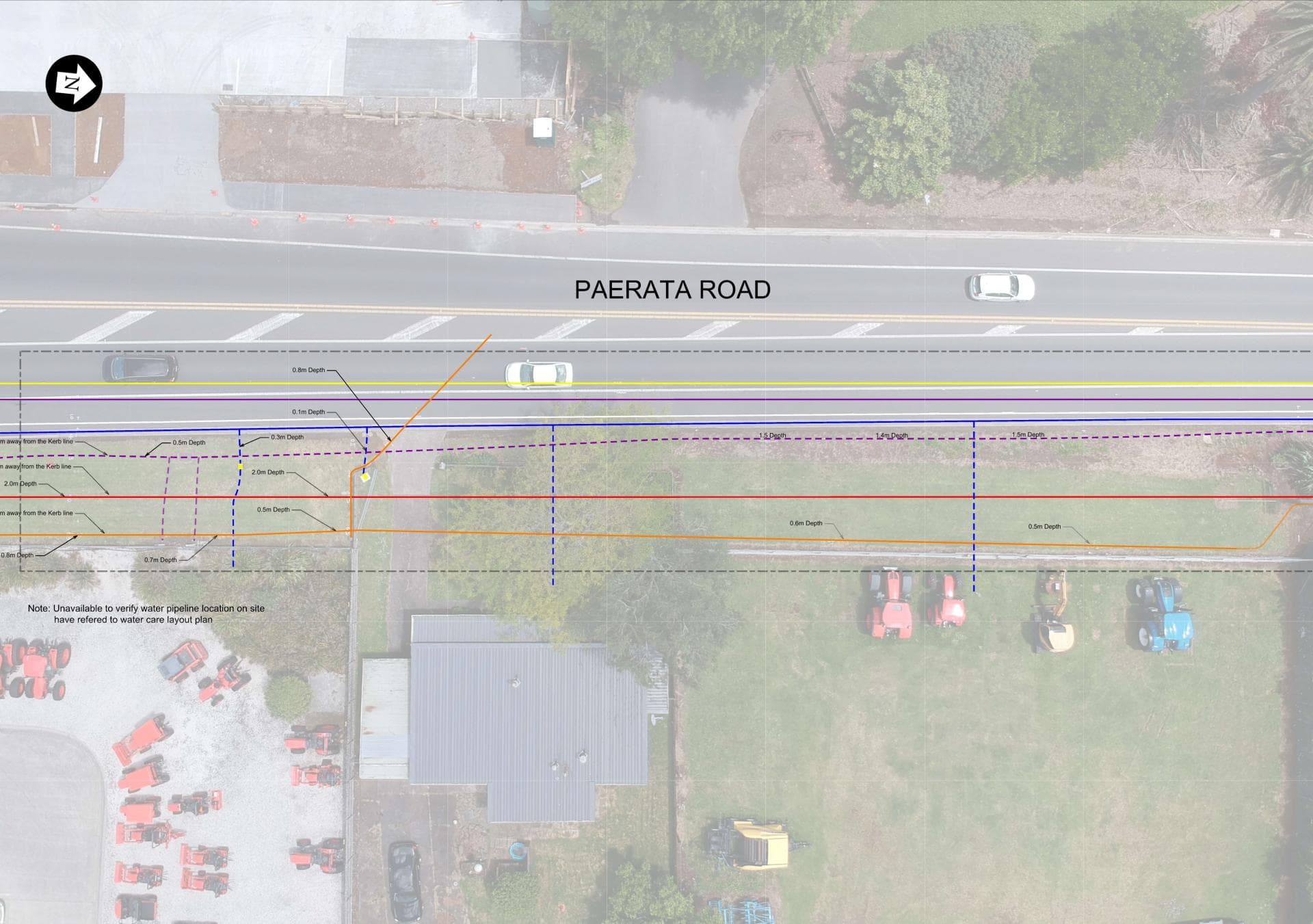
Service locating is the step that turns a plan into paint on the ground. A locator works through the site with several methods and marks what is actually there.
- Electromagnetic locating. A transmitter puts a signal onto a metallic pipe or cable, by direct connection, by a clamp or by induction, and a receiver traces it along the ground. Live power can often be picked up passively. This gives alignment and an estimated depth for anything conductive.
- Sondes and tracer wire. A small transmitter pushed through a non-metallic drain or duct on a rod, or the tracer wire laid with modern PE pipe, lets plastic services be traced the same way.
- Ground penetrating radar. GPR finds non-metallic services with no tracer wire, voids and tanks, and anything the records missed. It is more or less effective depending on soil; our guide to GPR accuracy in New Zealand soils covers where it works and where it struggles.
- Potholing. Where a service will be crossed or worked beside, it is physically exposed with hand tools or a hydro excavation truck so that its true position and depth are known, not estimated. This is the only way to reach QL-A, the top quality level, and it is what the asset owners' conditions usually require inside their exclusion zone anyway.
- Marking and recording. Paint, pegs or flags on the ground, and if you need it, a survey-grade GPS record for the drawings.
The practical difference is accountability. The plans come with a disclaimer. The mark-out comes from someone who stood on your site with instruments and will tell you how confident they are in each line. Our underground service detection and mapping page describes the methods in more depth.
Why this matters more in Auckland and the Waikato
Every region has its own ways of surprising a digger. In older Auckland suburbs the berms carry three generations of services: original cast iron or asbestos cement water mains, overhead-to-underground power conversions laid at odd depths in the 1980s and 1990s, copper telephone cable, and fibre pulled through in the last decade, often shallow where the ducting ran out. Infill housing has added private laterals and power runs across sections that no plan shows. In Franklin and North Waikato, former farmland now in subdivisions is riddled with unrecorded stock water lines, old power to pumps and irrigation mains. Lifestyle blocks have decades of owner-installed pipe between the house, the sheds and the troughs, laid at whatever depth the digger happened to reach. On the Hauraki Plains, high groundwater and peat mean services have moved since they were laid. None of this is on a beforeUdig plan.
The sequence that works
- Lodge the beforeUdig enquiry at least a week before you need to dig, and keep every response and its conditions.
- Read the conditions, not just the maps. Note any stand-over requirements and exclusion zones.
- Book a service locate for the whole dig area, including private services. Give the locator the plans, any as-builts and what the owner knows or suspects is in the ground.
- Pothole every crossing and anything inside an exclusion zone before mechanical digging starts, so depth is known rather than assumed.
- Keep the marks alive. Paint wears off and pegs get kicked. Refresh them if the job runs long or the surface is disturbed.
- Dig to the rules. Hand tools or hydro excavation inside exclusion zones, machine outside them, and stop if anything unexpected shows up.
- Record what you found. If you expose an unrecorded service, photograph and measure it. The next person to dig there will thank you.
What a locate costs against a strike
Leak detection and service detection jobs can start from $300 +GST. Every job is different, so call 0800 779 588 and we'll talk through your situation and give you an estimate. What moves a locate is the area to cover, how congested the ground is, whether anything needs potholing and whether you need a drawing at the end. Set that against the other side of the ledger. Repair of a damaged fibre cable is invoiced by the network owner at its cost and can run to several thousand dollars for a single cable, far more for a trunk route. A damaged power cable means a network crew, a shutdown and potentially an investigation. A broken water main means the flooding, the repair and the reinstatement. And every strike stops your job for days. In our experience the locate pays for itself on almost every site where anything is known to be buried, and on infill and former farmland that is every site.
How Utility Works does it
We are both the locating company and the excavation company, which changes the job. The person who paints the marks is on site when the ground is opened, so there is no argument about what the paint meant. We carry electromagnetic locators, GPR and sondes on the same truck as the hydro excavation gear, so a service can be traced, potholed and confirmed in one visit. And because we trench, lay mains and repair leaks ourselves, we read plans the way an installer does, which is how you spot the rider main on the other side of the road or the second duct nobody recorded. Two recent jobs show the range. In May 2026 we had to reach live gas pipes two metres down for a link-up, through overburden full of volcanic boulders, on a site where no hydrovac could get in; the pipes' position was detected and traced in from over 100 metres away so the benched excavation went exactly where it needed to. On a South Auckland mapping project in July 2025 the crew had tracked and traced over 200 individual pipes, cables, ducts and drains with more still to go, and in October 2026 a detection and mapping job at Auckland's largest wastewater treatment plant ran to hundreds more. None of those services were where a plan alone would have put a digger. Our pre-dig services investigation covers everything from a single trench across a lawn to a full subdivision stage, and our hydro excavation and potholing service exposes anything critical without touching it.
If you are about to dig anywhere from Auckland down through Franklin to Hamilton or across to Thames, lodge your beforeUdig enquiry, then call us on 0800 779 588 with the plans. We will tell you what the site is likely to hold that the plans do not show, and what a locate and pothole will cost before you break ground.
Frequently Asked Questions
Is beforeUdig legally required in New Zealand?
The service itself is free and voluntary, but the duty behind it is not. Under the Health and Safety at Work Act 2015 anyone running an excavation must identify and manage the risk of buried services, and WorkSafe treats obtaining plans as the minimum. Road controlling authorities require an enquiry number before issuing a corridor access request, and network owners expect one before any work near their assets.
Are beforeUdig plans accurate?
They are records, not surveys. They show approximate alignment, rarely show depth, and only cover registered owners' assets up to your boundary. Private services, abandoned mains and anything relaid without being recorded will not appear. Treat them as a guide to what to look for, not a mark-out.
Do I still need a locator if the plans show nothing in my area?
Yes, on almost any site. "No assets" means no registered owner has recorded anything there. It does not cover private water lines, power to sheds and pumps, irrigation, old drainage or anything a previous owner buried. On former farmland and infill sites that is where most strikes happen.
How long are beforeUdig plans valid?
Each asset owner sets its own validity, but most treat plans as current for about a month. If your dig is delayed beyond that, lodge a new enquiry so you are working from current records and have a current enquiry number.
What does a professional service locate cost?
Leak detection and service detection jobs can start from $300 +GST. Every job is different, so call 0800 779 588 and we'll talk through your situation and give you an estimate. The area to cover, how congested the ground is, potholing of crossings and whether you need a drawing are what change it.
What happens if I hit a service without having lodged an enquiry?
You are liable for the repair, which the network owner carries out and invoices at its cost, and you may face action under the relevant electricity, gas or telecommunications legislation. If anyone is hurt, WorkSafe will want to see what steps you took to identify the risk. An enquiry number and a locate report are the evidence that you took it seriously.
What is the difference between locating and potholing?
Locating traces a service from the surface with instruments and marks its approximate position and estimated depth. Potholing physically exposes the service with hand tools or hydro excavation so its exact position and depth are seen. Asset owners generally require potholing inside their exclusion zones before any mechanical digging nearby.
Let's discuss your underground project needs. Contact us today for a free, no-obligation quote.
Free, no-obligation quote · Mon–Fri 7am–5pm · Auckland, Franklin & North Waikato