
Articles & Advice · 18 December 2025
Overhead to Underground Power Conversion in NZ: Cost, Process and Is It Worth It?
Most of the overhead lines you see in Auckland and the Waikato are the network's, and they are not going anywhere soon. The line from the street to your house is different. That one is usually yours, and it can be put underground. This guide covers what a conversion involves, who does which part, what decides the cost for a house, a lifestyle block and a subdivision, how long the lines company takes, and when it is worth doing.
An overhead service line was the standard way to connect a New Zealand house for most of the last century: a pole or a fuse at the street, a span of cable across the front yard, a bracket on the fascia and a run down to the meter box. Thousands of homes in Auckland's older suburbs, in Pukekohe and Waiuku, and on rural properties from Franklin to Huntly still have exactly that. Converting it to an underground cable is one of the more common jobs on our power cable crews' calendar. It is straightforward when the sequence is right and frustrating when it is not, mostly because three or four parties have a hand in it.
What you own and what the network owns
The lines company owns the network up to the point of supply, which for most properties is at or near the road boundary. In Auckland that company is Vector; in Franklin and the northern Waikato it is Counties Energy; around Hamilton and Huntly it is WEL Networks; across to Thames and the Hauraki Plains it is Powerco. Everything from the point of supply to your switchboard is the consumer's: the service line, any private poles carrying it and the meter box. That is why a conversion is your project to commission and pay for, with the lines company approving and connecting it rather than doing the work.
Rural properties often have several private poles between the road and the house, sometimes a kilometre of them. Those poles are the owner's responsibility too, and lines companies have been writing to owners about ageing private poles for years. Replacing rotten poles is often what prompts a conversion in the first place, because by the time two or three need replacing, trenching a cable starts to look like the cheaper and final answer.
Why people convert
- Reliability in weather. The January 2023 storms and Cyclone Gabrielle left parts of Auckland and the Waikato without power for days, and a large share of the faults were trees on overhead lines. A buried service line does not care about wind.
- Safety and clearances. Overhead lines constrain where you can build, plant and lift. Extensions, pools, sheds and scaffolding all have to keep clear of them. Underground, the constraint is a line on a plan.
- Appearance and value. Removing a pole from the front lawn and the cable across the view changes how a property presents, which is why conversions often happen alongside a renovation or before a sale.
- Capacity. Many older overhead services are small. If you are adding an EV charger, a heat pump hot water system or a workshop, the conversion is the moment to upsize the cable and the switchboard in one job. Our guide to EV charger installation and underground power cable work covers that side.
- Rotten private poles. As above, the cheapest way to deal with a failing run of private poles is often to stop needing them.
- Subdivision and new dwellings. New lots must be served underground, and adding a minor dwelling or converting a shed to a sleepout frequently triggers an upgrade of the whole service.
Who does what
A conversion involves four parties and the order matters.
- Your electrician designs the new installation, applies to the lines company, upgrades or replaces the meter box and switchboard, terminates the new cable and certifies the work. Prescribed electrical work has to be done by a registered electrician who issues a Certificate of Compliance and an Electrical Safety Certificate.
- The lines company approves the connection, specifies where the new point of supply will be (usually a pillar or boundary box at the front boundary), confirms cable and fuse sizes, and books the livening and the disconnection of the old overhead service.
- Your electricity retailer and metering company arrange any meter change and update the connection record.
- The civil contractor, which is where Utility Works comes in: locating existing services, trenching or thrusting the route, laying the duct and cable, installing the pillar, backfilling and reinstating, and recording where it all went.
Many people start by ringing an electrician, who then calls us for the ground work. Just as many start with us, and we bring in an electrician we work with regularly. Either way works; the mistake is to dig the trench before the lines company has said where the pillar goes.
The process step by step
- Scope and application. The electrician assesses the load and the switchboard, agrees a cable route with you and lodges an application with the lines company. Allow two to six weeks for approval depending on the network and the time of year.
- Service locating. Before anything is dug, we lodge a beforeUdig enquiry and locate the water lateral, gas service, comms lead-in, drainage and anything private along the route. On older sections this always finds something the plans do not show.
- Trenching or thrusting. Open trench across lawn and garden, typically to give 600 to 750 mm of cover to the cable depending on the lines company's rules and the duct used. Under driveways, paths and established gardens we thrust or directionally drill a duct instead of cutting the surface.
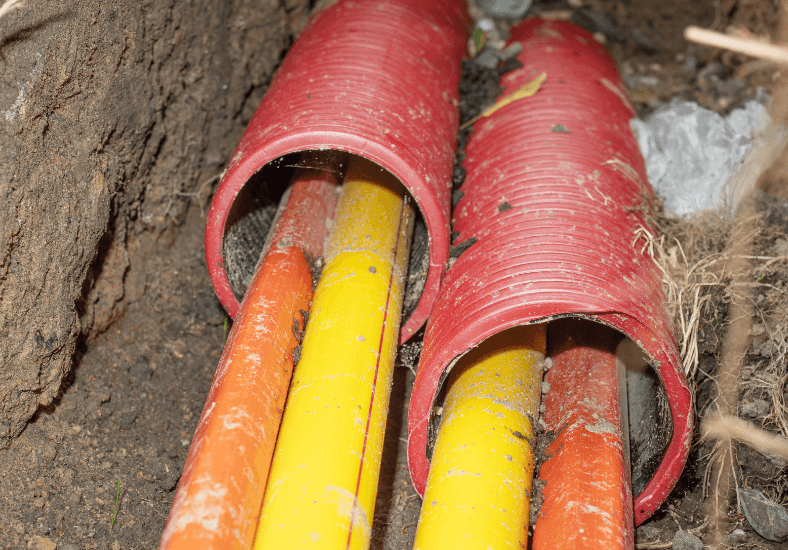
- Duct and cable. Heavy-duty orange electrical duct is laid with a draw wire, bedded and marker-taped, and the cable the electrician has specified, usually 16 mm² to 35 mm² for a house and larger for long rural runs, is drawn through. A spare duct for fibre or a future circuit costs little at this stage and saves a second trench later.
- Pillar and terminations. We set the pillar or boundary box at the point of supply. The electrician terminates both ends and completes the switchboard work.
- Inspection, livening and disconnection. The lines company's contractor connects the pillar to the network, livens the new service and disconnects the overhead. The old service cable comes down and the fascia bracket goes with it.
- Pole removal and reinstatement. Private poles are removed and the holes filled; network poles are the lines company's decision. Trenches are backfilled, compacted and the lawn, gravel or concrete made good.
- Records. We photograph and GPS the route so the next person to dig on the property knows where the cable runs.
What decides the cost
We quote every conversion from the site, not from a table, because the same job on two neighbouring properties can land a long way apart. These are the things that move it, roughly in order of how much they matter.
| Factor | Why it matters |
|---|---|
| Distance from the point of supply to the meter box | Sets the trench length and the cable length, and on long runs forces a larger cable to control voltage drop |
| What the route crosses | Lawn is trenched; concrete driveways, paths and established gardens are thrust or drilled under, which is slower per metre |
| Ground conditions | Rock and basalt floaters, high groundwater and heavy winter clay all slow the dig; a hydrovac on hand to clear a flooded trench, as on a mid-winter rural job of ours in July 2024, keeps it moving |
| Existing services on the route | Every water, gas, comms or drainage crossing has to be located and potholed before the machine goes near it |
| Private poles to remove | Each pole is a lift, a hole to fill and sometimes a stay to deal with |
| Switchboard and meter box condition | Older boards often need replacing at the same time; that is the electrician's part of the quote |
| Lines company requirements | Pillar type, fuse size and application fees vary between Vector, Counties Energy, WEL and Powerco |
| Other services going in the same trench | Water, fibre duct or gas duct laid alongside share the dig and bring the per-service cost down |
The cheapest conversions are the ones planned alongside other digging, such as a new driveway, a water lateral replacement or fibre, so the trench is shared. The most expensive are long rural runs through rock with several private poles and a switchboard that was never going to pass. Service detection to locate what is already in the ground comes first on every job. Leak detection and service detection jobs can start from $300 +GST. Every job is different, so call 0800 779 588 and we'll talk through your situation and give you an estimate.
How long it takes
The physical work is usually one to two days on site for a house and three to five for a long rural run. The calendar is set by the lines company. From lodging the application to livening, allow four to ten weeks in our experience, with the longer end over summer and after storms when networks are busy. If a meter change is needed the retailer's booking can add a week or two. Start the paperwork before you need the result.
Street-scale undergrounding is a different thing
People often ask whether the poles in the street can go too. Undergrounding the distribution network along a street is a lines company or council programme, funded and scheduled by them, and not something an individual can order. Auckland had a long-running programme funded through the consumer trust that has largely finished, and both Vector and Counties Energy now underground mainly where roads are rebuilt or networks are replaced. Converting your own service line does not remove the street poles, but it does remove the span to your house and any private poles on your land.
Is it worth it?
For a suburban home with a sound overhead service and no plans to add load, it is a comfort and appearance decision, and many owners quite reasonably leave it. It becomes clearly worth it when any of the following apply: private poles are failing, the service is too small for an EV charger or a renovation, trees keep taking the line out, you are building or extending near the line, you are subdividing, or you are already digging the front of the section for something else. In those cases the conversion pays for itself in avoided pole replacements, avoided outages and work you were going to do anyway, and it adds the kind of value a buyer notices.
How Utility Works does the ground work
Our crews locate every buried service on the route before the digger arrives, trench or thrust to the lines company's depth, lay duct and cable to specification, set the pillar and reinstate so the lawn and driveway look as they did. We work with registered electricians and with Vector, Counties Energy, WEL Networks and Powerco regularly, so the application, the pillar position and the livening booking are familiar ground. We have been mapping and working around one network provider's assets throughout its territory for over ten years, including substation mapping, which is the kind of familiarity that keeps a conversion off the lines company's problem list. Because we also lay water, fibre duct and gas duct, a conversion is often combined with other services in the same trench. The full service is on our underground power cable installation page, and for larger sites our complete utility installation page.
If you are thinking about taking your overhead service underground anywhere from the North Shore to Hamilton or Thames, call Utility Works on 0800 779 588. Tell us the distance from the road to the meter box and what sits in between, and we will give you an estimate and the order to do things in before you commit to anything.
Frequently Asked Questions
How much does it cost to convert overhead power to underground in NZ?
It depends on the distance from the boundary to the meter box, what the route crosses, the ground, how many private poles come out and whether the switchboard needs upgrading, so we quote from the site rather than a table. Call 0800 779 588 with your distance and what sits in between and we'll give you an estimate.
Who owns the power line from the street to my house?
Usually you do. The lines company owns the network up to the point of supply at or near your boundary. The service line from there to the switchboard, any private poles carrying it and the meter box are the property owner's, which is why the conversion is your project and your cost.
Do I need the lines company's permission?
Yes. Your electrician applies to Vector, Counties Energy, WEL Networks or Powerco for the new connection. They approve the pillar position and cable size, then liven the new service and disconnect the old one. Dig nothing until that approval is in hand.
How long does an overhead to underground conversion take?
One to two days of work on site for a house, three to five for a long rural run. From application to livening, allow four to ten weeks because the lines company sets the programme.
How deep is an underground power cable buried?
For a residential service in duct, typically 600 to 750 mm of cover depending on the lines company's requirements and the duct used, with marker tape above it. Under driveways the duct is thrust or drilled rather than trenched.
Can I get the street poles removed too?
Not as an individual. Street poles and the distribution lines on them are the network's, and undergrounding them is a lines company or council programme. Your conversion removes the span to your house and any private poles on your land.
Can I upgrade my power supply at the same time?
Yes, and it is the best time to do it. The new cable, pillar fuse and switchboard can be sized for an EV charger, a workshop or a minor dwelling in the same job, with a spare duct laid for fibre or a future circuit.
Let's discuss your underground project needs. Contact us today for a free, no-obligation quote.
Free, no-obligation quote · Mon–Fri 7am–5pm · Auckland, Franklin & North Waikato