
Articles & Advice · 22 October 2026
High Water Bill? How to Spot a Hidden Underground Leak
A water bill that has suddenly doubled, with nothing changed at home, is the most common first sign of a hidden underground leak. This guide covers how to tell whether it really is a leak, where these leaks hide, who is responsible for the pipe, and what it takes to find and fix one across Auckland, Franklin and the Waikato.
A water bill that climbs with no change in how much water you use is the clearest early sign of a hidden underground leak. These leaks rarely show on the surface, so the meter and the bill usually notice before you do. If your usage has jumped and nothing at home has changed, it is worth confirming a leak before it gets worse and more expensive.
Is a high water bill always a leak?
No. Before you assume the worst, rule out the simple causes: a toilet that runs on after flushing, a dripping tap or mixer, a hot-water cylinder relief valve weeping, a new dishwasher or irrigation system, or summer watering you have forgotten about. A single estimated meter reading can also make one bill look high and the next one low.
What points to a leak is a sustained, unexplained jump: your usage is well up, it stays up across more than one bill, and you cannot tie it to anything you are actually using. On a rural property fed by a bore or tank, the same problem shows as a pump that keeps cycling and a tank that drops overnight.
How to check for an underground leak yourself
You can confirm water is escaping on your side of the meter in about half an hour, with no tools:
- Turn off every tap, appliance and anything that uses water, inside and out.
- Find your water meter, usually at the boundary near the toby, and read it, including the small dials.
- Wait 30 to 60 minutes without using any water.
- Read the meter again. If the numbers have moved, water is leaving your pipes somewhere between the meter and the house.
If the meter has moved, you have a leak on your side. If it has not, the loss may be on the public side, or the high bill may be genuine use rather than a leak.
Where underground water leaks hide
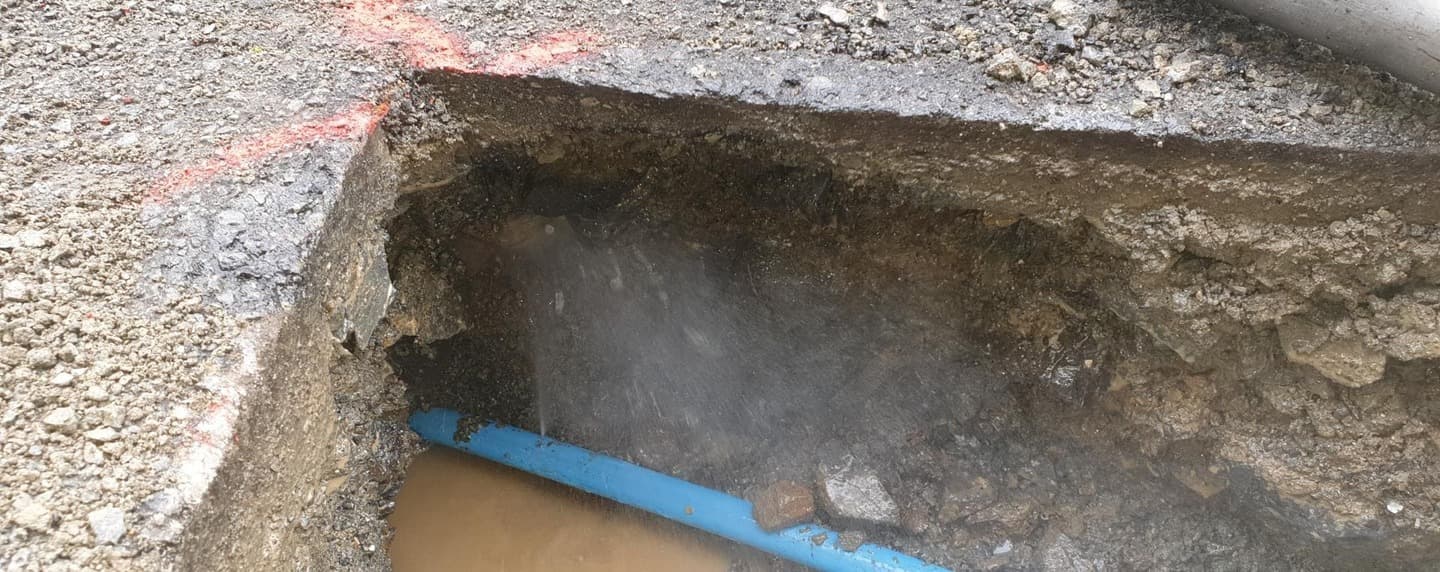
Underground leaks are easy to miss because the water almost never surfaces directly above the break. Common spots are under driveways and concrete, along the supply line between the toby and the house, under lawns and gardens, and on the long private lines that feed rural homes, sheds and troughs.
The ground changes what you see. On the clay soils common across much of Auckland and Franklin, water from a leak spreads sideways and can surface well away from the pipe, or sit underground with no wet patch at all. On Pukekohe's free-draining volcanic loam it soaks straight down, so the usual tell-tale damp patch often never appears and the bill is the first warning. Older homes add a clue of their own: galvanised steel and alkathene supply lines corrode and split from the inside, so a 1960s or 70s connection is a prime candidate.
Why you should not just dig where it is wet
Because the wet patch, if there is one, is rarely above the leak. Digging on a guess tears up a driveway or lawn and often misses the break anyway. We trace the route of the pipe first, then pinpoint the leak with acoustic listening equipment and correlators, so the hole goes in the right place the first time. That is the difference between one small, neat excavation and a dug-up yard.
Is the leak your responsibility or the council's?
As a rule, the network owner, Watercare in Auckland or the district water provider in the Waikato, owns and maintains the main and the service pipe up to the point of supply, usually your meter and toby at the boundary. Everything from there to the house, under your driveway and across your section, is yours to maintain and repair.
The meter test above tells you which side you are on. If the meter keeps moving with every tap in the house turned off, the leak is on your side, and that is the part we find and fix. If you suspect it is on the network side, report it through your water provider.
What it costs to find and fix
Leak detection and service detection jobs can start from $300 +GST. Every job is different, so call 0800 779 588 and we will talk through your situation and give you an estimate. Because we own the diggers, trucks and crew, the same team that finds the leak can dig it out, repair the pipe and reinstate the surface. You make one call and deal with one contractor, rather than waiting on a plumber, then an excavator, then someone to patch the concrete.
Don't let a leak keep running up the bill
A hidden leak only gets more expensive, and on a pressurised line it can undermine a driveway or foundation over time. If your water bill has jumped and the meter test says water is moving, underground leak detection will find it precisely before it does more damage. We cover Auckland, Franklin, North Waikato and Hauraki.
Frequently Asked Questions
Can a small underground leak really double my water bill?
Yes. A leak you cannot see runs continuously, day and night. Even a slow seep adds up fast when it never stops, and a split on a pressurised line can waste thousands of litres a week, which is enough to double or triple a normal bill.
How do I know if the leak is on my side or the council's?
Turn off every tap and appliance and watch your meter for 30 to 60 minutes. If it keeps moving with no water being used, the leak is on your side, between the meter and the house. If it does not move, the loss is likely on the network side and should be reported to your water provider.
Will an underground leak always show as a wet patch?
No. On clay ground the water often spreads sideways or stays below the surface, and on free-draining soils like Pukekohe's volcanic loam it soaks straight down with no patch at all. A rising bill is frequently the only sign, which is why we trace and listen rather than look for damp.
How much does it cost to find an underground water leak?
Leak detection and service detection jobs can start from $300 +GST. Every job is different, so call 0800 779 588 and we will give you an estimate. One crew finds the leak and, if you want, digs it out and repairs it.
Which areas do you cover?
We work across Auckland, Franklin, North Waikato and Hauraki, from our base at Waiau Pa in South Auckland.
Let's discuss your underground project needs. Contact us today for a free, no-obligation quote.
Free, no-obligation quote · Mon–Fri 7am–5pm · Auckland, Franklin & North Waikato