
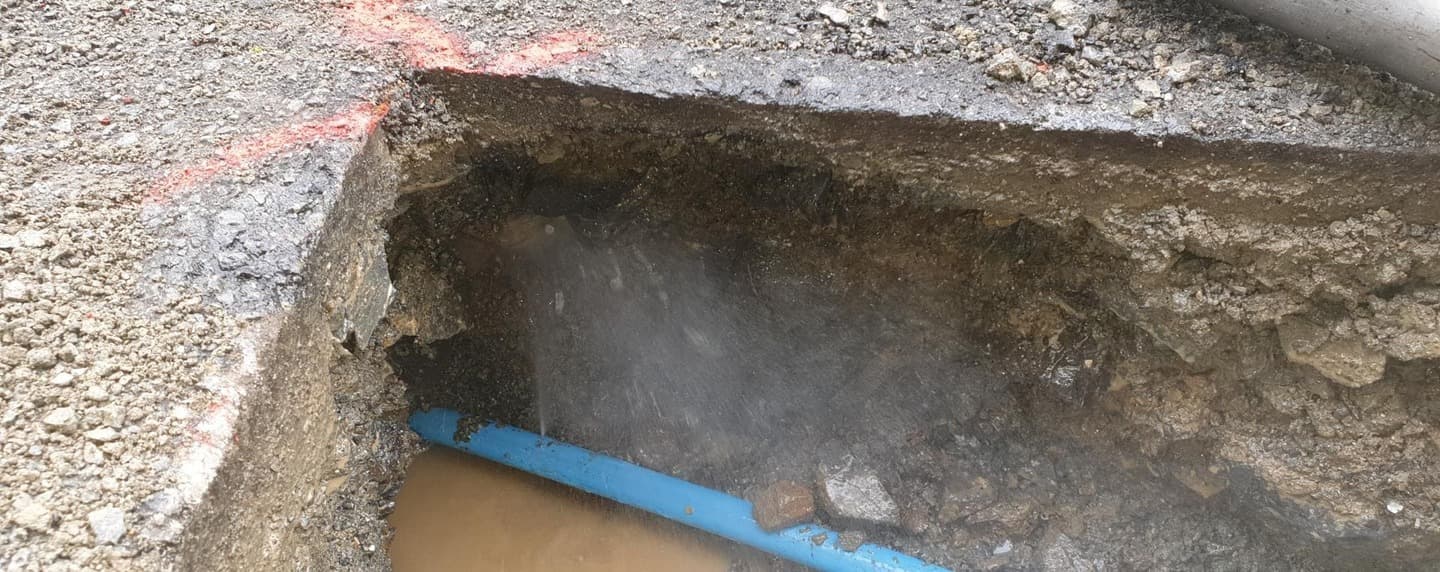
Leak Detection in Manukau
Local leak detection for Manukau and the wider South Auckland area
Since 2015Own locators, hydro-vac & diggersAuckland · Franklin · North Waikato
Leak detection and service detection jobs can start from $300 +GST. Every job is different, so call 0800 779 588 and we’ll talk through your situation and give you an estimate.
Leak Detection for Manukau properties, sites and farms
A leak under a Manukau industrial yard does not show on the surface. The concrete and asphalt hide it, the busy site drowns out the sound and the only evidence is a Watercare bill creeping upward month after month. Utility Works quantifies the loss with night-flow testing at the meter, isolates sections to narrow it, then pinpoints the leak with acoustic correlation and tracing through the hard surfaces. Our own hydro-vac and excavator open a small hole in the right place, repair the pipe and reinstate the yard.
Typical leak detection jobs in Manukau
- Night-flow testing and leak location on warehouse and distribution sites in Wiri
- Pinpointing leaks under trafficked yards and car parks without closing the site
- Tracing and repairing failing mains serving large-format retail and commercial premises
Leak Detection, in short
Water from a broken pipe rarely surfaces where the break is. We find the exact spot with acoustic listening gear, leak correlators, pipe tracing and, where it helps, ground penetrating radar and thermal imaging, so the dig is small and in the right place. Then the same crew excavates with our own digger or hydro-vac truck, repairs the pipe and reinstates the lawn, driveway or concrete. We work on everything from a single house connection to retirement villages, schools, farms and industrial sites, and we test afterwards so you can see the loss has stopped.
Full details: Underground Leak Detection & Repair →Working underground in Manukau
Manukau is South Auckland's commercial centre, with the city-centre precinct, the Wiri industrial area and a wide belt of warehousing, transport yards and large-format retail around it. Most of the sites are big, hard-surfaced and busy, which makes any excavation expensive if it goes in the wrong place.
A great deal of the private pipework under those yards went in when the area was first developed and has been added to since. Ageing mains run under concrete and asphalt that cannot easily be lifted, so a leak often shows as a rising Watercare bill long before any water reaches the surface.
Water and wastewater are reticulated by Watercare. We work across Manukau for property managers, facility teams and contractors who need a leak pinpointed under a trafficked yard or services marked before pavement, drainage or building work, and who want the same crew to do the dig afterwards.
When Manukau’s homes were built, and what that means for leaks
The age of a house tells us what pipe and cable to expect underneath it before we arrive.
Before 1960
Manukau Central was open farmland in the rural Wiri district. The railway has run through Wiri since 1875 and the railways quarry on Wiri Mountain began supplying ballast in 1915, but there was no town.
1960s to 1980s
Manukau City Council formed in 1965, bought the land for its new centre in 1966, and the mall opened in October 1976 with the council building the year after. Wiri became a large industrial area through the same two decades, and Rainbow's End opened in 1982.
1985 to 2000
Manukau Supa Centa opened on the western side in 1998 and the Pukaki bridge of 1996 linked the centre toward the airport. Quarrying on Wiri Mountain ran on until the 1990s, leaving a lake below the surrounding ground.
Since 2000
The Puhinui interchange (2003), the events centre (2005), the MIT campus over the station (2014), the bus station (2018) and the Tech Park (2020) rebuilt the centre around transport, and the quarried mountain became Basalt Business Park, finished by January 2025.
What Manukau’s water pipes are made of, and how they fail
Because almost nothing in Manukau Central predates 1966, there is little galvanised steel here. The city-centre precinct and the first Wiri factories were plumbed in the asbestos-cement and copper era: AC mains under the roads and car parks, copper and early PVC laterals into the buildings, and, on the bigger sites, private fire mains in cast iron or AC that have been extended several times. AC fails at joints and under traffic load, so a leak under a trafficked yard is usually a joint, not a pinhole.
The Supa Centa, Rainbow's End and the 1990s warehouses carry the first PVC and MDPE, often without tracer wire, which means an electromagnetic locator cannot find them and we fall back on GPR and a sonde pushed through the pipe. Everything at the Tech Park, the bus station and the new Basalt Business Park is PE100 with tracer wire and proper as-builts. The trap on Manukau sites is the join between generations: a 2010s MDPE extension tied into a 1970s AC main with a fitting nobody recorded. That is where we find most of the leaks, and where potholing earns its keep.
Why leaks are hard to find in Manukau’s basalt and scoria
Manukau sits at the southern end of the Auckland volcanic field. Matukutūruru, or Wiri Mountain, erupted about 30,000 years ago and its lava spread across roughly 18 hectares, up to 18 metres deep, a kilometre north and 1.5 kilometres south of the cone. The three Puhinui craters sit to the west, and Ash Hill, a small tuff cone, has been flattened under the industrial area. The mountain was quarried from 1915 to the 1990s, so much of Wiri is jointed basalt, scoria and quarry fill.
Basalt cuts both ways. Water from a broken main runs through fractured rock and old scoria without surfacing, so a Wiri leak can be a long way from any wet patch and we rely on acoustic correlation and isolation testing. The rock also stops a digger, so we cut and hydro-vac rather than trench. On the flats toward the city centre and Puhinui Creek the ground is softer clay and silt that holds water, where damp patches appear. GPR reads cleanly through scoria and dry fill but poorly through saturated clay, and slab reinforcing masks what is beneath it, so on a Manukau yard we pair ground scan, slab scan and sonde.
Source: Wikipedia, Matukutūruru / Wiri (Auckland volcanic field)
Who owns the pipes in Manukau
Which network a service belongs to decides who fixes it, who you call first and whose plans a beforeUdig request returns.
Water supply
Watercare supplies Manukau and Wiri. On a commercial site the point of supply is the outlet of the master meter, so the private network behind it, fire mains and sub-meters included, is the owner's to find and fix.
Wastewater
Watercare runs the sewer and trade-waste network. Large Wiri sites often carry private process drains and interceptors on no Watercare plan; we locate those too.
Electricity
Vector supplies Manukau, inside the old Auckland Electric Power Board area, with heavy underground feeds into the industrial precinct. Any unmarked cable near a Wiri switchroom is live until proven otherwise.
Gas
Manukau is on Vector's list of areas with piped gas, and many Wiri factories run gas-fired plant on large mains. We locate the gas before anyone digs; anything to do with the gas itself is Vector's job.
Fibre and phone
Chorus owns the street fibre and copper. Vector Fibre runs a separate business-only network across Auckland, 1,700 kilometres of it, so a Wiri site may have its duct beside the Chorus lead-in.
beforeUdig plans
A Manukau request returns plans from Watercare, Vector (electricity, gas and fibre), Chorus and Spark. They stop at the boundary; the private yard network behind the master meter, most of what is under a Wiri site, is not on them.
One crew for Manukau: find it, dig it, fix it.
Manukau is around 35 minutes from Waiau Pa along the motorway, so we do not treat it as a long run and we can be on site at Wiri for an early start without trouble.
Get a free quoteNeed leak detection in Manukau? Call us for a free, no-obligation quote.
Free, no-obligation quote · Mon–Fri 7am–5pm · Auckland, Franklin & North Waikato
Google reviews
What customers say
“Prompt service & fair pricing. Tony and his team — sharp eye for detail and out of the box problem solving paired with a high standard of workmanship.”
Richard La Trobe · Google · October 2026
“Really happy with the work to install our underground services. Highly recommend.”
Sarah Walworth · Google · October 2026
“The only company we trust… reliable, cost effective, and honest service from A to Z. 100% confidence in this company.”
Darrel Assink · Google · September 2026
Our Projects
1–2 of 4
South Auckland
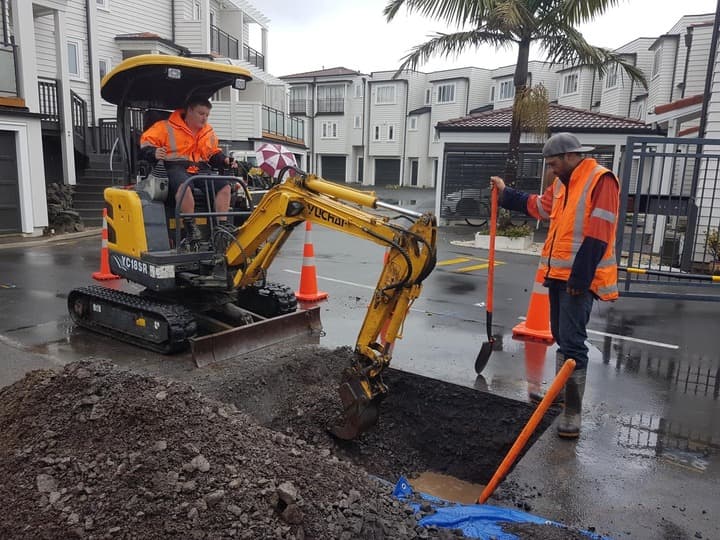
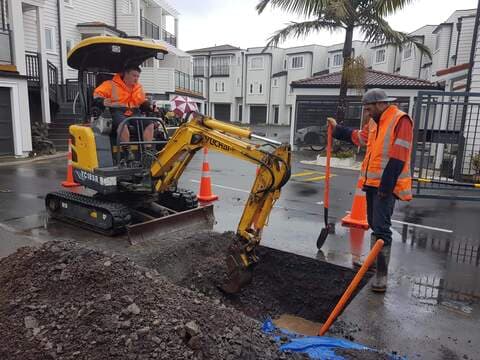
Retirement Village Water Leak Detection & Repair
A large retirement village of 58 units in South Auckland had been experiencing underground water loss. Utility Works conducted system loss testing, system mapping, mark-out and CCTV/sonde pinpointing of joint and tapping band positions, isolation point installation, followed by acoustic and infrared detection works. Once leak positions were located, we implemented strategic excavation and pipe repairs, followed by ground reinstatement and site clean-up. This successful project resulted in the accurate locating and repair of five leak positions, and provided substantial water savings to the client.
Read the case study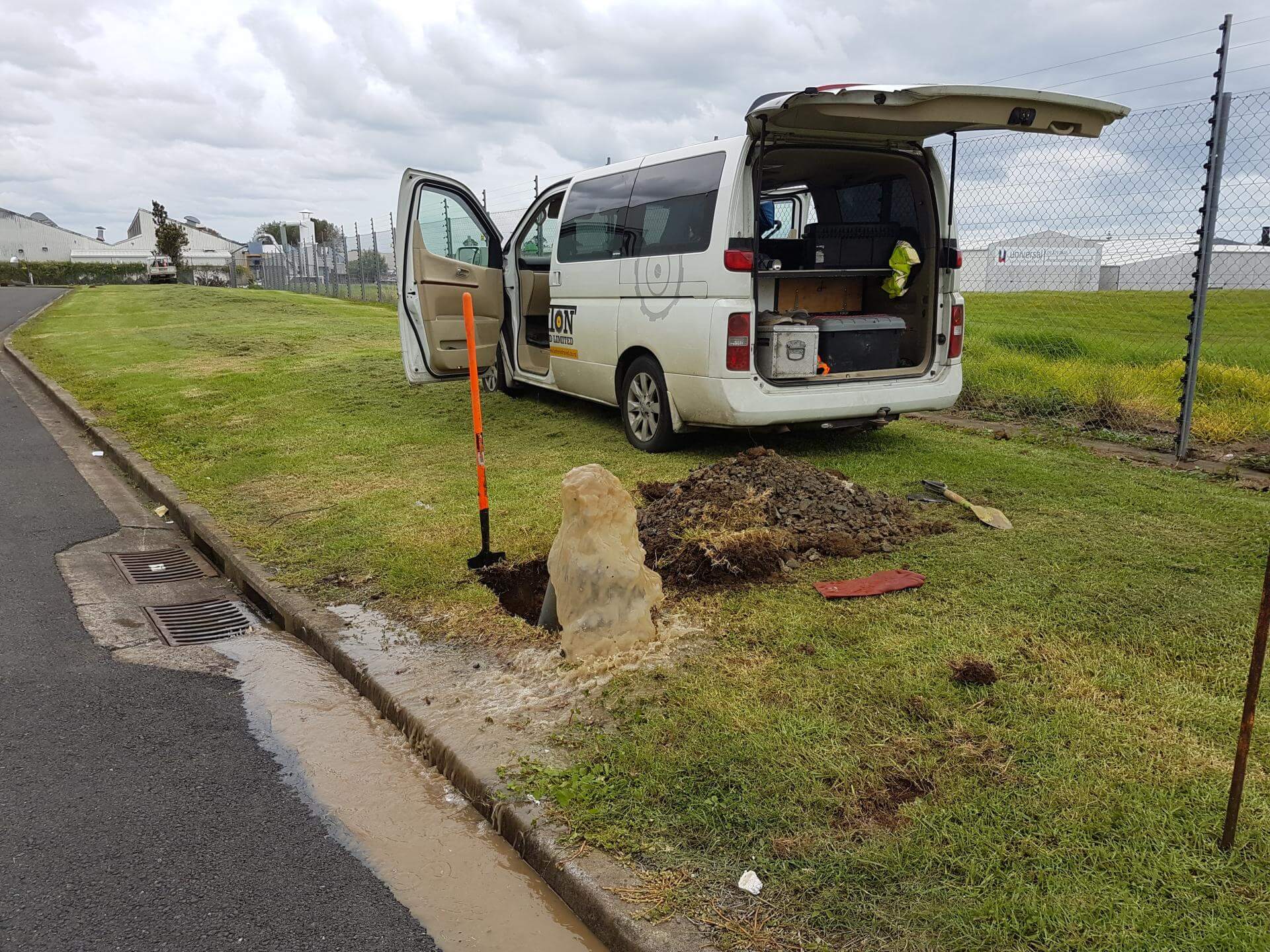
East Tāmaki, Auckland
Industrial Property Water Loss Investigation
A large, 14-hectare industrial property in East Tāmaki was experiencing a high-volume water-loss issue. The busy site was losing in excess of 170 L/min and substantial works had already been undertaken to attempt locating the leak before Utility Works was engaged. We undertook a strategic approach to the investigation including a full site audit and partial mapping of the 180mm mains and isolation testing, followed by IR, GPR, and acoustic works which enabled us to pinpoint the leak, have the position excavated, and the leak repaired overnight.
Read the case studyLeak Detection nearby
Other services in Manukau
Leak Detection in Manukau: your questions
Our Manukau site has one Watercare master meter and several tenancies. How do you find which one is leaking?
Why has a Manukau leak not shown on the surface when the bill says we are losing water?
Does Manukau's ground make leaks harder to find than in the suburbs?
Ready when you are.
Tell us what you’re seeing or what you’re planning. You’ll get a straight answer, a free quote and one crew that does the whole job.
Mon–Fri 7am–5pm · Waiau Pa, South Auckland · Auckland, Franklin & North Waikato