
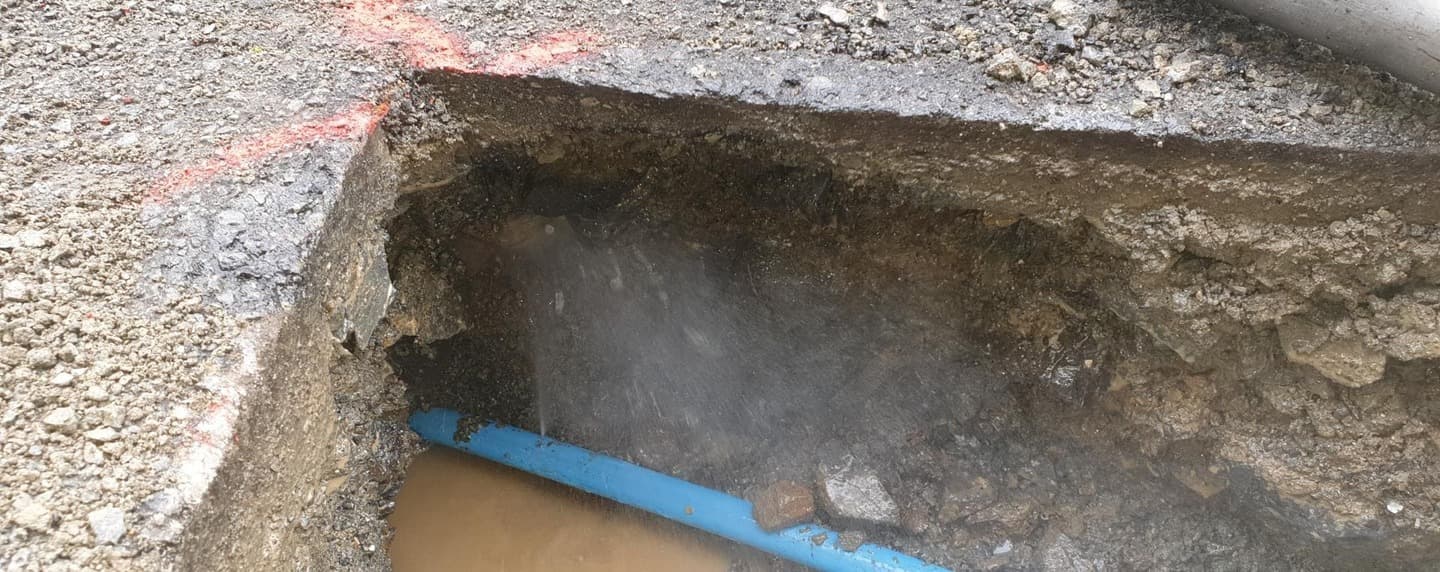
Leak Detection in South Auckland
Local leak detection across South Auckland: Papakura, Takanini, Conifer Grove, Ōpaheke, Manurewa, Clendon Park, Weymouth, Wiri, Manukau, Ōtara, Māngere, Karaka, Drury
Since 2015Own locators, hydro-vac & diggersAuckland · Franklin · North Waikato
Leak detection and service detection jobs can start from $300 +GST. Every job is different, so call 0800 779 588 and we’ll talk through your situation and give you an estimate.
Leak Detection for South Auckland properties, sites and farms
Leaks across South Auckland follow the housing. In Ōtara, Māngere, Manurewa and Papakura the 1950s to 70s galvanised laterals are pinholing under driveways and the asbestos-cement mains they hang off are cracking at the joints. In Wiri, Manukau and the Māngere industrial blocks the losses are bigger and invisible, under hardstand on private networks nobody has mapped. On the new Takanini and Drury subdivisions it is broken fittings and as-builts that lie. We quantify the loss at the meter, isolate the section, pinpoint with acoustic correlation and ground microphones, choose the method for the ground, lava, peat or clay, and then dig and repair it with our own crew.
Typical leak detection jobs in South Auckland
- Pinpointing galvanised lateral pinholes under driveways in Ōtara, Māngere and Papakura state-house streets
- Night-flow testing and leak location on private networks under Wiri and Manukau industrial yards
- Finding failed fittings and mis-recorded laterals on new Takanini and Drury subdivisions
- Isolating and repairing leaks on shared supplies and cross-lease sections in Manurewa and Clendon
Leak Detection, in short
Water from a broken pipe rarely surfaces where the break is. We find the exact spot with acoustic listening gear, leak correlators, pipe tracing and, where it helps, ground penetrating radar and thermal imaging, so the dig is small and in the right place. Then the same crew excavates with our own digger or hydro-vac truck, repairs the pipe and reinstates the lawn, driveway or concrete. We work on everything from a single house connection to retirement villages, schools, farms and industrial sites, and we test afterwards so you can see the loss has stopped.
Full details: Underground Leak Detection & Repair →Working underground in South Auckland
South Auckland was farmland until the Southern Motorway pushed through in the 1950s, and most of what is under its streets went in over the next thirty years. Ōtara's state housing started in 1958 and had 3,000 houses within a decade, central Māngere followed in 1962, Papakura, Manurewa and Takanini had grown into one built-up area by 1964, and Manukau's new city centre opened its mall in 1976. That is a lot of galvanised and asbestos-cement pipe wearing out together.
The ground changes quickly. Māngere, Wiri and Puhinui sit on the lava and scoria of the Auckland volcanic field, the Takanini and Papakura flats are drained peat and soft Tauranga Group clays with groundwater a metre down, and the harbour edge at Weymouth, Clendon and Conifer Grove is estuary margin. Each hides a leak differently, so we never assume the wet patch marks the pipe.
The work splits three ways. In the state-housing belt it is failed laterals, shared supplies on cross-leases and new townhouses tying into old mains. In Wiri, Manukau and the Māngere industrial blocks it is private networks under hardstand that no public plan covers. In Takanini, Drury and Ōpaheke it is greenfield subdivision, with up to 22,000 homes planned around Drury alone, where as-builts seldom match the ground. Watercare supplies all of it from the Hūnua dams and the Waikato, Vector carries the power to Papakura and Counties Energy beyond, and our Waiau Pa yard is 25 to 40 minutes away.
When South Auckland’s homes were built, and what that means for leaks
The age of a house tells us what pipe and cable to expect underneath it before we arrive.
Before 1960
Papakura (borough 1938) and Manurewa (borough 1937) were small railway towns, and Māngere Bridge had suburban streets from the 1870s. State housing began at Ōtara in 1958, chosen for the motorway and the Ōtāhuhu and Penrose factories.
1960s to 1980s
The bulk of South Auckland: central Māngere's state housing from 1962, Ōtara's 3,000 houses by 1968, Manurewa East and Weymouth through the 1970s, Conifer Grove from 1974, Clendon Park from 1979, and Manukau's planned centre around the 1976 mall.
1985 to 2000
Growth slowed after the 1980s closures. Clendon's shops opened in 1984 and its streets ran on toward Weymouth, Manukau Supa Centa came in 1998, and Papakura District replaced Papakura City in 1989.
Since 2000
Takanini doubled between 2013 and 2023 on former army and golf-course land, Papakura grew by a third between 2018 and 2023, and the 2019 Drury-Opāheke structure plan allows up to 22,000 homes on about 1,900 hectares.
What South Auckland’s water pipes are made of, and how they fail
Three pipe generations sit side by side across South Auckland. The 1950s and 60s state houses in Ōtara, Māngere and Papakura got galvanised steel laterals off cast iron and asbestos-cement mains; the galvanised pipe is rusting through and pinholing under driveways, and the AC mains crack at the joints. Manurewa, Weymouth and Clendon's 1970s and 80s streets are the asbestos-cement and copper generation, with Dux Quest polybutylene inside the later houses.
Takanini, Drury and the Manukau rebuilds since 2000 are MDPE and PE100 with tracer wire, except that fast subdivision leaves as-builts that do not match the trench and landscapers break the fittings. The 1990s laterals in between, PVC and early alkathene with no tracer wire, are invisible to an electromagnetic locator. So the common South Auckland job is a section with a 1960s galvanised line into a 2010s townhouse, where we first find out what is actually there with GPR and a sonde.
Why leaks are hard to find in South Auckland’s mixed ground
North to south, South Auckland is volcanic field, then soft flats, then clay hills. Māngere Mountain, the Wiri lava flows and the Puhinui craters belong to the Auckland volcanic field and put basalt, scoria and tuff near the surface in Māngere, Wiri and parts of Ōtara. From Manurewa south the Takanini and Papakura flats are drained peat and pumiceous Tauranga Group clays up to 20 metres deep, with groundwater a metre down in summer and near the surface in winter. South of Papakura the land lifts onto clay, with old lava from Pukekiwiriki at Red Hill.
On the lava a leak drains away through rock and shows nowhere near the pipe, and the digger meets basalt. On the peat flats everything is wet already, so a damp lawn means little, trenches flood and slump, and GPR loses depth. On the clay hills water surfaces along the trench rather than above the break. The Papakura Stream floods in heavy rain and runs to the Manukau Harbour.
Who owns the pipes in South Auckland
Which network a service belongs to decides who fixes it, who you call first and whose plans a beforeUdig request returns.
Water supply
Watercare supplies the region, mostly from the four Hūnua dams via the Ardmore plant east of Papakura, topped up from the Waikato plant at Tuakau. The point of supply is the meter outlet; the lateral to the house is yours.
Wastewater
Watercare runs the sewers. A few lifestyle blocks around Karaka, Ōpaheke and Drury are still on septic tanks; we locate the tank and field before digging there.
Electricity
Vector runs from Wellsford to Papakura and covers Māngere, Ōtara, Manukau and Manurewa. Counties Energy takes over on Papakura's southern fringe and runs to Mercer, so Drury, Karaka and Ōpaheke are usually Counties.
Gas
Vector's gas list includes Māngere, Manukau, Takanini, Papakura, Drury and Kingseat, so expect a gas main in most berms. We locate the pipe; anything to do with the gas itself is Vector's job.
Fibre and phone
Chorus built Auckland's UFB fibre and owns the copper under it. Vector Fibre's business-only network means a Wiri or Māngere industrial boundary may carry two fibre owners.
beforeUdig plans
A request returns Watercare, Vector (electricity, gas and fibre), Chorus and Spark, plus Counties Energy south of Papakura. Plans show presence, not position, and never private pipes.
Jobs we have done here
Recent work around South Auckland
In Tony's words, from the Utility Works Facebook page. Clients unnamed, as they are there.
“Superb day smashing out a fire hydrant installation at a South Auckland yard. Another quality job completed by the team.”
Underground Utility Installation · South AucklandTony Eggleton · October 2026
“The team has been busy this week in South Auckland on ground testing pits ahead of a major infrastructure upgrade: ten areas service detected, hydro-slotted as required and then carefully excavated with the digger. All completed safely and on schedule.”
Underground Service Locating · South AucklandTony Eggleton · August 2026
“Another quality water mains renewal completed for a South Auckland retirement village, right through to the final reinstatement, landscaping and clean down.”
Water Mains Replacement · South AucklandTony Eggleton · April 2026
“Another services detection and mapping project under way for a long-term client in South Auckland. Over 200 individual pipes, cables, ducts and drains tracked and traced so far, with more to go.”
Underground Service Locating · South AucklandTony Eggleton · July 2025
“Water mains replacement in South Auckland.”
Water Mains Replacement · South AucklandTony Eggleton · July 2023
One crew for South Auckland: find it, dig it, fix it.
South Auckland is 25 to 40 minutes from our yard at Waiau Pa, Papakura closest and Māngere furthest, so travel adds little to a quote
Get a free quoteNeed leak detection in South Auckland? Call us for a free, no-obligation quote.
Free, no-obligation quote · Mon–Fri 7am–5pm · Auckland, Franklin & North Waikato
Google reviews
What customers say
“Prompt service & fair pricing. Tony and his team — sharp eye for detail and out of the box problem solving paired with a high standard of workmanship.”
Richard La Trobe · Google · October 2026
“Really happy with the work to install our underground services. Highly recommend.”
Sarah Walworth · Google · October 2026
“The only company we trust… reliable, cost effective, and honest service from A to Z. 100% confidence in this company.”
Darrel Assink · Google · September 2026
Our Projects
1–2 of 4
South Auckland
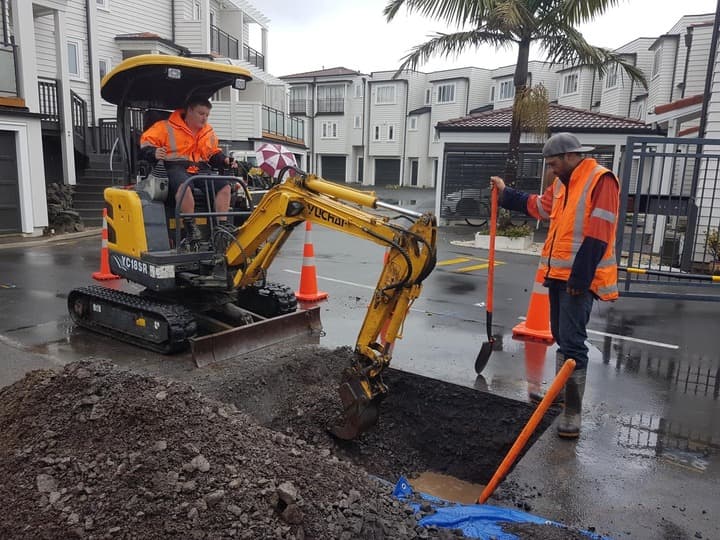
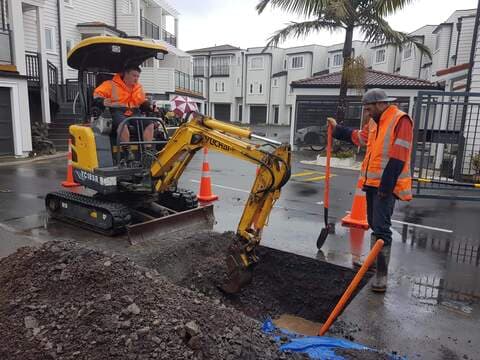
Retirement Village Water Leak Detection & Repair
A large retirement village of 58 units in South Auckland had been experiencing underground water loss. Utility Works conducted system loss testing, system mapping, mark-out and CCTV/sonde pinpointing of joint and tapping band positions, isolation point installation, followed by acoustic and infrared detection works. Once leak positions were located, we implemented strategic excavation and pipe repairs, followed by ground reinstatement and site clean-up. This successful project resulted in the accurate locating and repair of five leak positions, and provided substantial water savings to the client.
Read the case study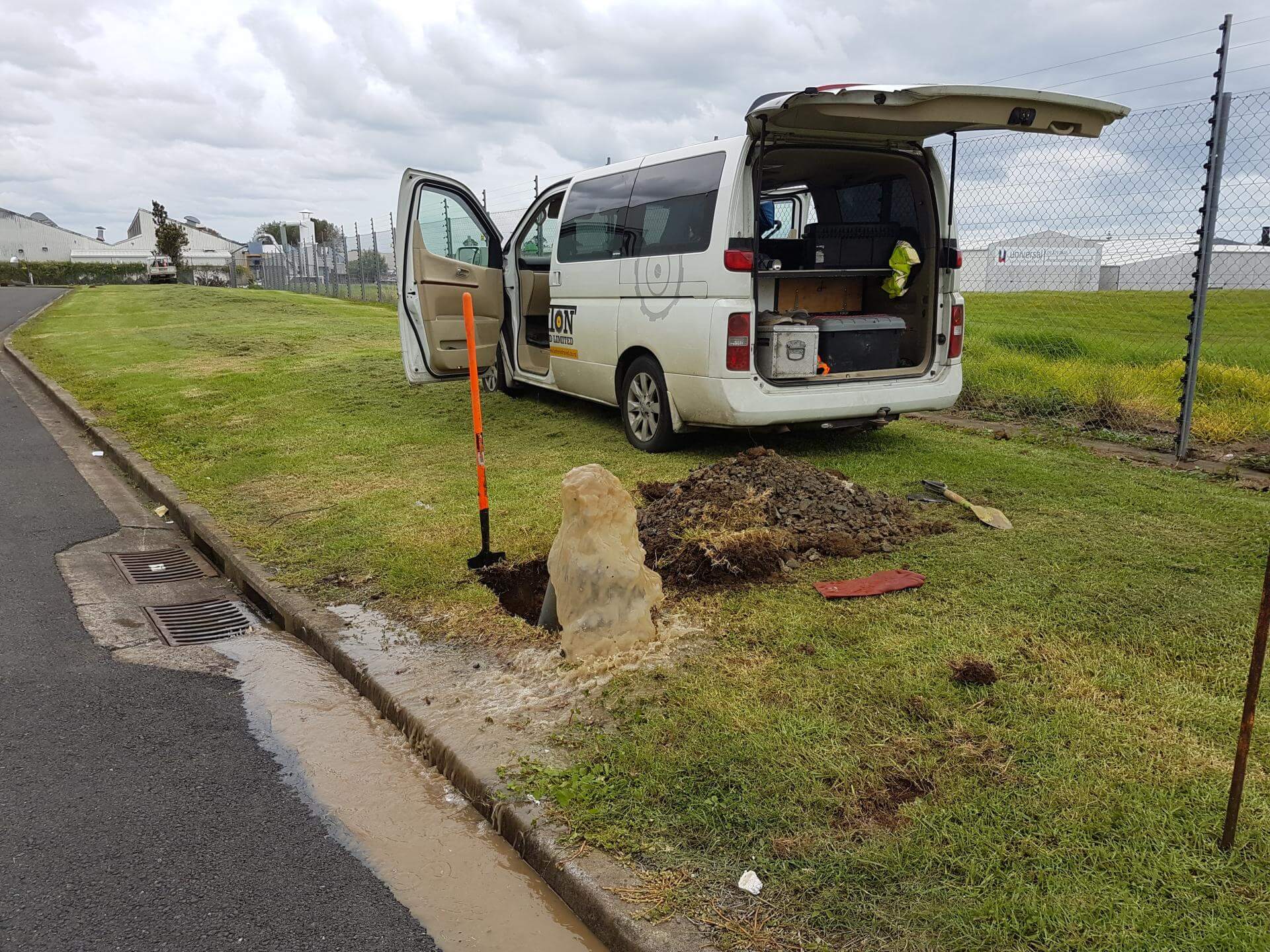
East Tāmaki, Auckland
Industrial Property Water Loss Investigation
A large, 14-hectare industrial property in East Tāmaki was experiencing a high-volume water-loss issue. The busy site was losing in excess of 170 L/min and substantial works had already been undertaken to attempt locating the leak before Utility Works was engaged. We undertook a strategic approach to the investigation including a full site audit and partial mapping of the 180mm mains and isolation testing, followed by IR, GPR, and acoustic works which enabled us to pinpoint the leak, have the position excavated, and the leak repaired overnight.
Read the case studyLeak Detection by suburb in South Auckland
Other services in South Auckland
Leak Detection in South Auckland: your questions
Do you cover all of South Auckland, or just Papakura?
Who is responsible for a leak between the road and my house in South Auckland?
Why do South Auckland's 1960s houses leak so much?
Does the ground in South Auckland change how you find a leak?
Ready when you are.
Tell us what you’re seeing or what you’re planning. You’ll get a straight answer, a free quote and one crew that does the whole job.
Mon–Fri 7am–5pm · Waiau Pa, South Auckland · Auckland, Franklin & North Waikato