
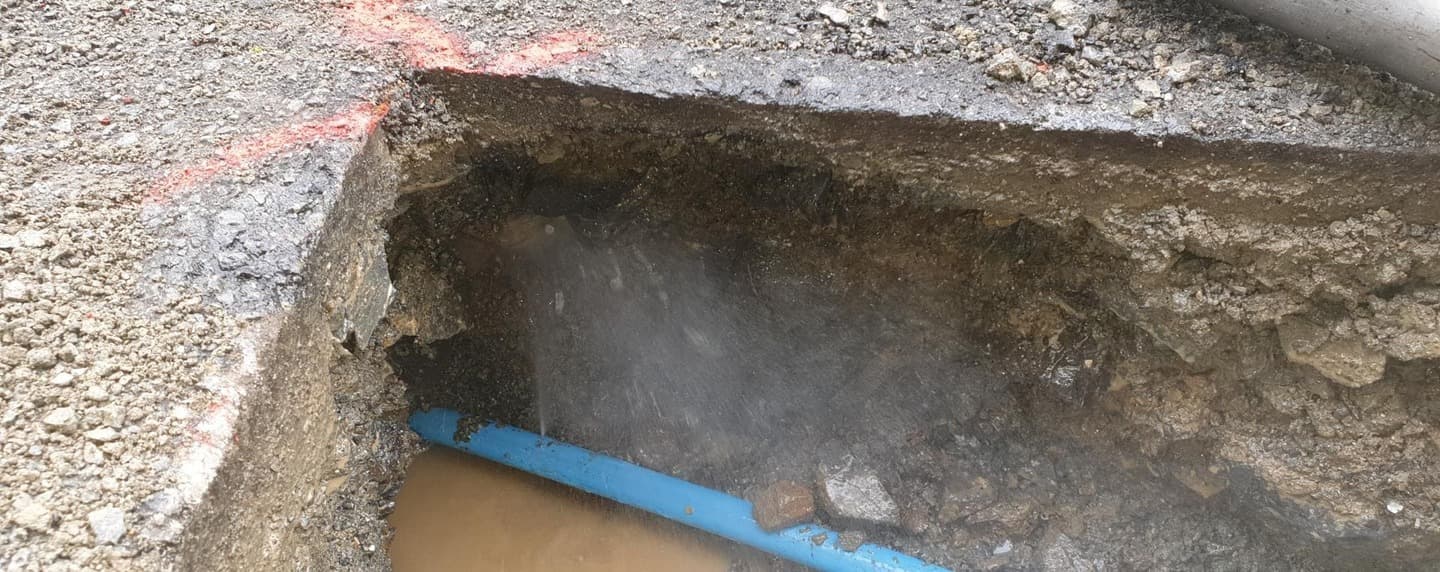
Leak Detection in Ngāruawāhia
Local leak detection for Ngāruawāhia and the wider North Waikato & Hamilton area
Since 2015Own locators, hydro-vac & diggersAuckland · Franklin · North Waikato
Leak detection and service detection jobs can start from $300 +GST. Every job is different, so call 0800 779 588 and we’ll talk through your situation and give you an estimate.
Leak Detection for Ngāruawāhia properties, sites and farms
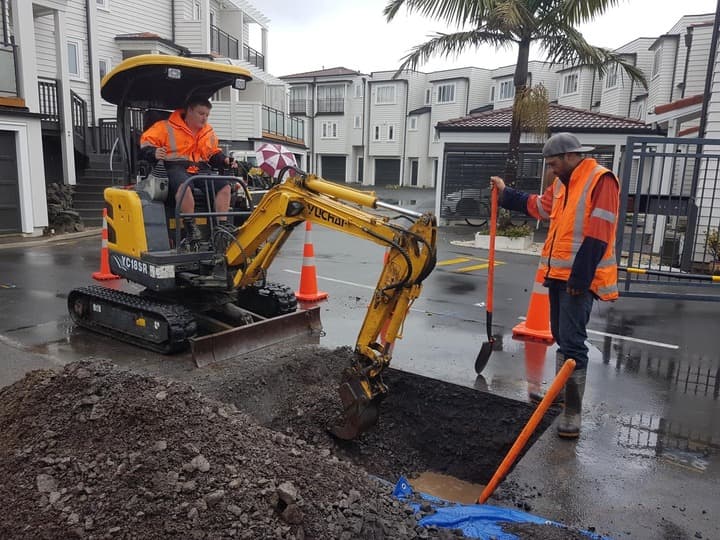
Ngāruawāhia has a lot of mid-century housing on mid-century pipe, and the galvanised lines that served those homes for decades are now springing pinhole leaks and failing at the fittings. On the river flats the high water table hides the escaping water, so the first sign is often a Waikato District Council bill that has jumped. Utility Works traces the pipe, pinpoints the leak acoustically and repairs it with our own excavator and crew, keeping the hole small on sections that are often tight.
Typical leak detection jobs in Ngāruawāhia
- Acoustic detection and repair on ageing galvanised connections in established streets
- Finding leaks on new infill connections that have been cut into old mains
- Tracing leaks on rural lines feeding houses and stock across river-flat farmland
Leak Detection, in short
Water from a broken pipe rarely surfaces where the break is. We find the exact spot with acoustic listening gear, leak correlators, pipe tracing and, where it helps, ground penetrating radar and thermal imaging, so the dig is small and in the right place. Then the same crew excavates with our own digger or hydro-vac truck, repairs the pipe and reinstates the lawn, driveway or concrete. We work on everything from a single house connection to retirement villages, schools, farms and industrial sites, and we test afterwards so you can see the loss has stopped.
Full details: Underground Leak Detection & Repair →Working underground in Ngāruawāhia
Ngāruawāhia sits where the Waipā River joins the Waikato, a few minutes north of Hamilton on the old State Highway 1 route. It is a long-established town with much of its housing dating from the middle of last century, and the pipework serving those homes is often of a similar vintage.
The town is growing again as Hamilton commuters look north for more affordable sections, and new homes are being built on the edges and on infill lots. New connections being cut into old mains, and new services going into berms that were never mapped properly, make locating essential before any excavation.
Low-lying ground on the river flats has a high water table, which makes trenches wet and leaks hard to see. Waikato District Council runs water and wastewater in town, while rural properties around Ngāruawāhia rely on bores, river takes and private lines running across paddocks.
When Ngāruawāhia’s homes were built, and what that means for leaks
The age of a house tells us what pipe and cable to expect underneath it before we arrive.
Before 1960
Pākehā settlement began in 1864 on confiscated land at the river junction, and the grid of streets between the Waikato and the Waipā dates from then. Villas and cottages from the railway and bridge years (road bridge 1921, replaced by the steel truss bridge in 1956) fill the older blocks nearest the confluence and Tūrangawaewae.
1960s to 1980s
Slow, steady building rather than a boom. The weatherboard and brick homes on the flat east of Great South Road are mostly from these decades and make up the bulk of the town's older stock.
1985 to 2000
Little new housing. Ngāruawāhia still had only 5,334 people in 2006, so late-century homes are a few cul-de-sacs rather than whole subdivisions.
Since 2000
The growth years. The expressway bypass opened in December 2013, the population rose 40 per cent between 2013 and 2023 to 7,992 in 2,442 dwellings, and the Galbraith Street infrastructure funded in 2022 is opening up about 200 more homes within walking distance of the town centre.
What Ngāruawāhia’s water pipes are made of, and how they fail
Two generations of pipe sit side by side here. Under the older grid it is galvanised steel laterals off cast iron or asbestos-cement mains, with the usual results: rust-choked galvanised that pinholes, and AC that cracks at the joints when the river-flat ground shifts. Copper laterals from the 1960s and 70s last better, but their brass fittings corrode in wet ground and the first sign is often a damp patch at the toby.
The post-2013 houses are on MDPE laterals and PVC or PE mains, often cut into those old mains at a saddle. The weak points are the new fittings, especially where fencing or landscaping went in after the plumber left, and as-builts from fast-built stages that do not match the trench. New plastic without tracer wire is invisible to an electromagnetic locator, so on a 2015 section we go to radar and a hydro-vac pothole, while on a 1950s section the metal pipe traces cleanly from the toby. Where a new connection has been cut into an old AC main, the saddle itself is a common leak point.
Why leaks are hard to find in Ngāruawāhia’s river terraces
The town sits on the flats where the Waipā joins the Waikato, at the foot of the Hakarimata Range. The flats are the northern end of the same volcanic alluvium that underlies Hamilton, spread across the basin about 20,000 years ago when a dam of Taupō ash gave way, so the ground is pumice sand and silt rather than clay. That is good radar ground, and the sand drains well enough that a leak often does surface eventually. The catch is the water table: in the August 2008 flood the river at Ngāruawāhia ran at three times its average flow, and the lowest streets near the confluence have groundwater close to the surface for much of the year.
Away from the rivers the ground rises and digs firmer and drier, so we check which part of town a job is on before we price it, because it changes the shoring and the pumping. The Lower Waikato flood scheme's 255 kilometres of stopbanks start downstream at Huntly, so along the town's own river frontage we assume wet ground and plan the dig around it.
Source: Wikipedia, Hamilton (Hinuera Surface) and Ngāruawāhia; Environment Waikato flood release 2008
Who owns the pipes in Ngāruawāhia
Which network a service belongs to decides who fixes it, who you call first and whose plans a beforeUdig request returns.
Water supply
IAWAI Flowing Waters has run Ngāruawāhia's drinking water and wastewater since 1 July 2026, taking over from Waikato District Council. The town's connections are metered and read every six months. Under the district bylaw the point of supply is the meter and toby at the boundary: IAWAI maintains the service pipe to that point and you maintain the supply pipe beyond it.
Wastewater
IAWAI runs the sewer network in town; lifestyle blocks along the river flats and up the Waipā are on septic tanks.
Electricity
WEL Networks supplies Ngāruawāhia, as it does Hamilton and most of the Waikato District; around half its network is underground.
Gas
We have not confirmed a reticulated natural gas supply in Ngāruawāhia; the Firstgas distribution region covers the Waikato, so check with Firstgas before you assume a berm is gas-free.
Fibre and phone
Ultrafast Fibre, now Tuatahi First Fibre, connected Ngāruawāhia early in its small-town rollout; Chorus still owns the copper.
beforeUdig plans
A beforeUdig request here returns IAWAI, WEL Networks, Tuatahi, Chorus and Firstgas plans for the road reserve. Private laterals, farm lines and the services on new lots laid before the as-built was lodged are not on them.
One crew for Ngāruawāhia: find it, dig it, fix it.
Ngāruawāhia is about 80 minutes from Waiau Pa straight down the expressway, so we quote it as a full day's work, and travel is a small part of the cost on a job of any size.
Get a free quoteNeed leak detection in Ngāruawāhia? Call us for a free, no-obligation quote.
Free, no-obligation quote · Mon–Fri 7am–5pm · Auckland, Franklin & North Waikato
Google reviews
What customers say
“Prompt service & fair pricing. Tony and his team — sharp eye for detail and out of the box problem solving paired with a high standard of workmanship.”
Richard La Trobe · Google · October 2026
“Really happy with the work to install our underground services. Highly recommend.”
Sarah Walworth · Google · October 2026
“The only company we trust… reliable, cost effective, and honest service from A to Z. 100% confidence in this company.”
Darrel Assink · Google · September 2026
Our Projects
1–2 of 4
South Auckland
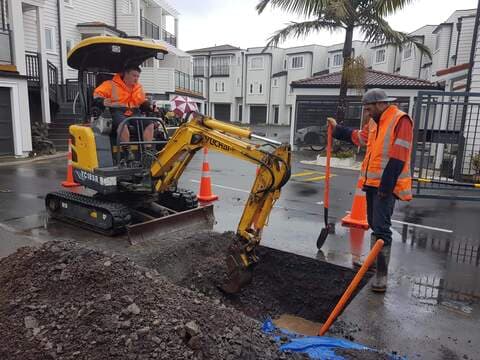
Retirement Village Water Leak Detection & Repair
A large retirement village of 58 units in South Auckland had been experiencing underground water loss. Utility Works conducted system loss testing, system mapping, mark-out and CCTV/sonde pinpointing of joint and tapping band positions, isolation point installation, followed by acoustic and infrared detection works. Once leak positions were located, we implemented strategic excavation and pipe repairs, followed by ground reinstatement and site clean-up. This successful project resulted in the accurate locating and repair of five leak positions, and provided substantial water savings to the client.
Read the case study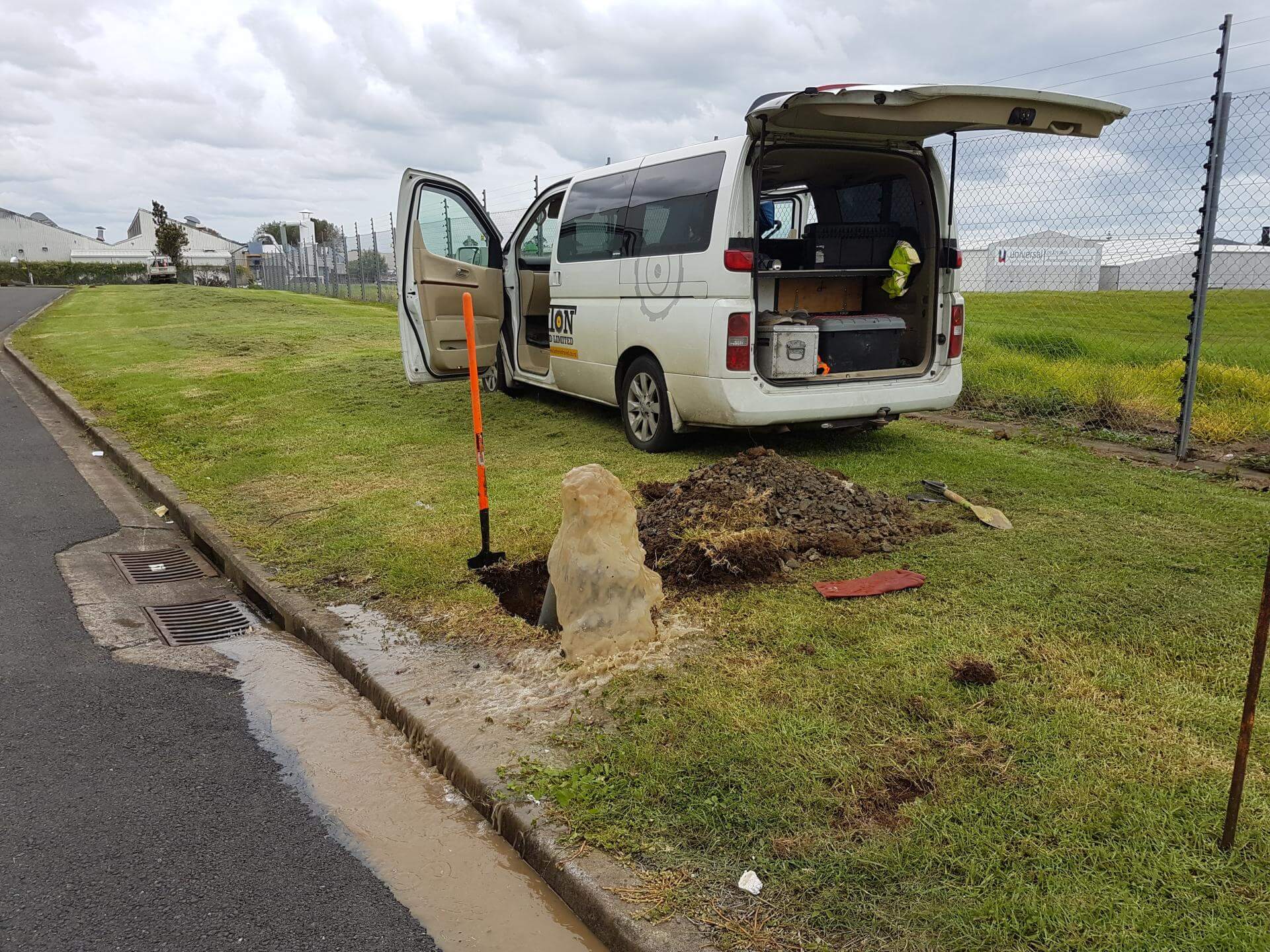
East Tāmaki, Auckland
Industrial Property Water Loss Investigation
A large, 14-hectare industrial property in East Tāmaki was experiencing a high-volume water-loss issue. The busy site was losing in excess of 170 L/min and substantial works had already been undertaken to attempt locating the leak before Utility Works was engaged. We undertook a strategic approach to the investigation including a full site audit and partial mapping of the 180mm mains and isolation testing, followed by IR, GPR, and acoustic works which enabled us to pinpoint the leak, have the position excavated, and the leak repaired overnight.
Read the case studyLeak Detection nearby
Other services in Ngāruawāhia
Leak Detection in Ngāruawāhia: your questions
Who is responsible for a water leak between the meter and my house in Ngāruawāhia?
Can IAWAI reduce my Ngāruawāhia water bill after a leak?
Why do water leaks on the river flats in Ngāruawāhia take so long to show?
Ready when you are.
Tell us what you’re seeing or what you’re planning. You’ll get a straight answer, a free quote and one crew that does the whole job.
Mon–Fri 7am–5pm · Waiau Pa, South Auckland · Auckland, Franklin & North Waikato