
Articles & Advice · 21 October 2026
Hydro Excavation and Hydrovac Cost in NZ: When to Use It Instead of a Digger
A hydrovac truck costs more per hour than a digger, so people assume it is the expensive option. On the right job it is the cheaper one, because the hole is smaller, nothing gets struck and nobody waits for a repair crew. This guide explains what hydro excavation is, what actually drives its cost in New Zealand, how that compares with mechanical excavation, and the situations where each one wins, with examples from our own jobs.
Hydro excavation, hydrovac, vacuum excavation, sucker truck: the names all describe the same method. Pressurised water breaks the ground up, a large vacuum hose lifts the resulting slurry into a tank on the truck, and what is left is a clean hole with whatever was buried in it sitting intact at the bottom. Utility Works runs its own hydro excavation trucks alongside its diggers and locating equipment across Auckland, Franklin, North Waikato and the Hauraki Plains, so we choose between water and steel every day. This is how we make that call, and what decides the cost either way.
How hydro excavation works
The truck carries a water tank, a high-pressure pump, a spoil tank and a vacuum blower. The operator directs a wand of water, typically at a couple of thousand psi, at the ground to cut and loosen it, while a 150 mm or 200 mm vacuum hose beside the wand draws the wet soil straight up into the spoil tank. The hole can be as small as 300 mm across and as deep as the hose will reach, usually three metres or more. Because water does not cut polyethylene, PVC, cable sheath or steel the way a bucket tooth does, a pipe or cable in the path of the wand is washed clean rather than damaged. Operators can also run air instead of water where dry spoil is wanted, though air is slower in clay.
What drives the cost of hydro excavation
We do not publish a rate card for the truck, because the hourly rate tells you very little about what a job will cost. Service detection and potholing are quoted together from the same phone call. Leak detection and service detection jobs can start from $300 +GST. Every job is different, so call 0800 779 588 and we'll talk through your situation and give you an estimate. These are the things that move a hydro excavation job up or down:
- How many holes and how deep. A single pothole to confirm one crossing is a different job from ten test pits for an infrastructure upgrade. Depth matters more than width; the vacuum works harder the further it has to lift wet spoil.
- The ground. Soft loam and moist clay cut quickly. Dry, compacted clay and engineered road base are slower and use more water. Basalt boulders stop the water altogether.
- Spoil disposal. Hydrovac spoil is slurry. It leaves the site in the tank, goes to a licensed facility and cannot be put back in the hole, so the hole is backfilled with imported granular material. More holes, more tank loads, more tips.
- Access and hose run. The truck parks on the road and the hose runs to the hole. A long run down a side path or across a yard is slower than a hole beside the kerb.
- The surface. Lawn is opened and closed in minutes. Concrete or asphalt is cored or saw-cut first and patched afterwards.
- What else is happening. A pothole done while our locating crew is already on site, or while the digger is running the trench between crossings, is far cheaper than a separate visit.
On hourly rate alone the truck costs more than the digger. The job cost is a different question, and that is what the rest of this guide is about.
Where hydro excavation wins
Anywhere near a known service
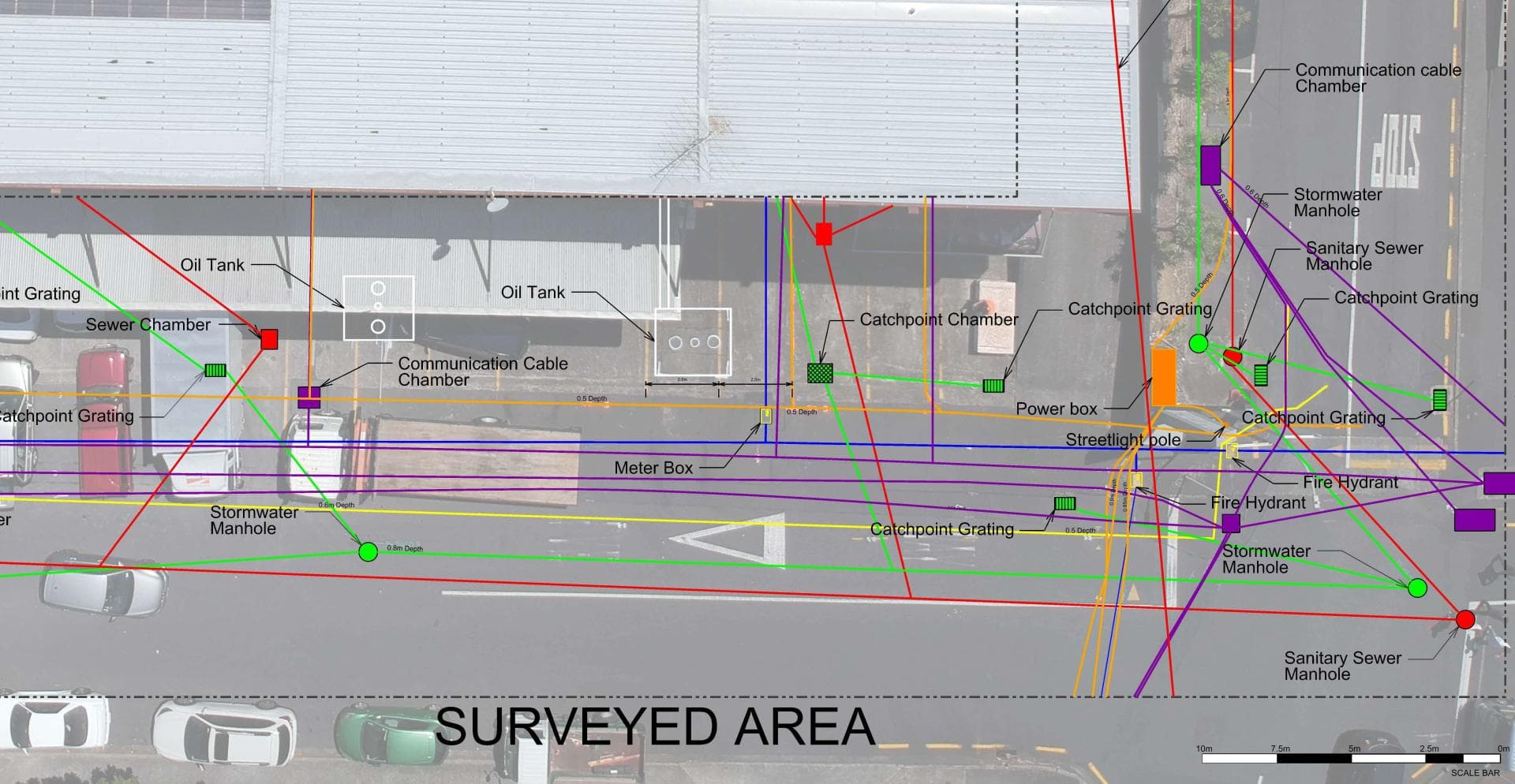
Most New Zealand asset owners prohibit mechanical excavation within a set distance of their assets, commonly half a metre to a metre either side, and require hand digging or vacuum excavation inside that zone. Hand digging a metre-deep hole in Auckland clay takes a person most of a morning. The hydrovac does it in twenty minutes with no risk to the person or the pipe. If your trench crosses three services, that is three potholes the rules say you cannot dig with a machine anyway.
Confirming depth before boring or piling
Directional drills and piling rigs work blind. A locate gives alignment and an estimated depth; a pothole gives the real depth to the millimetre. One exposed crossing is a small line on the invoice. One drilled fibre cable is a network owner's repair bill and a stopped job.
Congested ground
Older Auckland berms carry water, gas, power, copper and fibre within a metre of each other. Infill sites have private laterals criss-crossing the section. On ground like this a digger bucket is a liability and a hand shovel is slow. The vacuum lifts the soil out from between the services without touching them.
Small, deep holes
Pole holes, valve and hydrant chambers, meter pits, soak holes and foundation pads for pumps or EV chargers are all deep in relation to their width. A digger has to open a much larger hole to reach the same depth safely; the hydrovac goes straight down.
Tight access and finished surfaces
The truck parks on the road and the hose runs 30 to 60 metres to the hole, through a gate, down a side path or across a finished lawn. There is no tracking a machine over the landscaping, and a 300 mm hole in a driveway is cored, excavated and patched where a digger would have broken out a square metre.
Leak repairs
When our acoustic crew marks a leak on a lateral, the hydrovac opens that spot, and only that spot, in soft or hard ground alike. The leaking pipe is exposed without being damaged further, repaired, and the hole backfilled. It is the main reason we can detect and repair most residential leaks in one visit; the method is described on our leak excavation and repair page.
Flooded and wet trenches
The vacuum side of the truck works on its own. On a mid-winter rural power installation in July 2024 the trench kept filling with groundwater; our small hydrovac on site cleared it ahead of the cable lay and the connection, which would otherwise have been a pump, a wait and a muddy join. The same vacuum clears silted-up manholes, flooded cable pits, blocked culvert inlets and sumps without anyone climbing in.
Where a digger still wins
- Open trenching with nothing in the way. Once services are located and potholed, 80 metres of trench across a paddock is digger work. The hydrovac would take all day and fill several tanks.
- Bulk earthworks. Cutting a building platform or a driveway is not a hydro excavation job.
- Rock. Water will not cut basalt. In Auckland's volcanic areas the boulders have to be broken or lifted out mechanically.
- When the spoil needs to go back in. Hydrovac spoil leaves the site, so the hole is backfilled with imported material. For a large volume that matters. A digger stockpiles the spoil and puts it back.
- Remote sites with no disposal nearby. If the nearest licensed tip is an hour away, every tank load carries two hours of travel.
- Where the truck cannot get in. Sometimes neither the truck nor the hose can reach. In May 2026 we had to reach live gas pipes two metres down for a link-up, through overburden full of large volcanic boulders, on a site with no way to get a hydrovac in to pothole. The answer was careful benched excavation by digger and hand, with the pipes' position detected and traced in from over 100 metres away so the crew knew exactly where they were before the first bucket.
Comparing the two on real jobs
| Job | Digger | Hydrovac | Usual choice |
|---|---|---|---|
| Expose three service crossings on a new driveway trench | Not permitted inside exclusion zones; hand dig, most of a day for two people | About an hour and a half on site, three clean holes, services untouched | Hydrovac |
| 60 m water lateral replacement across a lawn, no crossings | Half a day, spoil returned to the trench | A full day plus two tanks of spoil and imported backfill | Digger |
| Pothole a leak under a concrete driveway | Break out a square metre, repair, re-pour | Core a 300 mm hole, excavate, repair, patch | Hydrovac |
| Ten test pits for an infrastructure upgrade in congested ground | Risky without exposure; slow by hand | Services detected, each pit hydro-slotted to prove them, then digger-excavated to size | Both, in that order |
| Trench 150 m for rural power cable across clay paddocks | A day, spoil returned | Several days and many tank loads | Digger, with hydrovac only at the farm water crossings |
The test pit row is a real August 2026 job: ten areas across a South Auckland site in preparation for a major infrastructure upgrade, each service-detected, hydro-slotted where the services ran, then carefully excavated by digger, all completed safely and on schedule. The pattern holds. Where the hole is small, deep, close to something or under something finished, the truck is cheaper once reinstatement, risk and the rules are counted. Where the hole is long, open and far from anything, the digger is cheaper. Most of our jobs use both: the hydrovac proves the crossings, the digger runs the trench between them.
New Zealand ground and the hydrovac
Hydro excavation is well suited to most of our region's soils. Waitemata and Franklin clays cut cleanly, although when they are dry and compacted the going is slower and uses more water. Pukekohe's volcanic loam is almost ideal. Sand and pumice are quick but the hole walls can slump, so holes are kept small. Peat on the Hauraki Plains fills with groundwater as fast as it is emptied, so the vacuum works harder and holes are sheeted if anyone needs to work in them. The one real obstacle is basalt in Auckland's volcanic areas, where floaters have to be broken out mechanically. In winter, wet clay makes the truck's job easier and the digger's harder, which is often the deciding factor between June and September.
What to tell us when you book
- What you need exposed and why: a crossing to confirm, a leak to repair, a pole hole, a pit to clean.
- Your beforeUdig plans and any as-builts, so we know what is likely to be there. If you have not lodged an enquiry yet, read our guide to what beforeUdig gives you and what it doesn't.
- Access: where the truck can park and how far the hose has to run.
- The surface: lawn, gravel, asphalt, concrete, and whether it needs to be reinstated to match.
- Whether the hole is being backfilled straight away or left open for another trade.
One company for locating, exposing and digging
The reason we run hydro excavation trucks rather than hiring them in is that the job rarely stops at the pothole. Our crews locate the services with electromagnetic equipment and GPR, expose the critical ones with the truck, then run the trench or make the repair with the digger, and the same people are responsible for all of it. There is no handover between a locating company, a vac truck hire and a digger operator, no argument about what the paint meant, and no waiting between steps. The service is described on our hydro excavation and potholing page, and the locating that comes before it on our pre-dig services investigation page.
If you have crossings to confirm, a leak to expose, pits to clean or a job where a digger is not allowed, call Utility Works on 0800 779 588. Tell us what is in the ground and what sits on top of it and we will tell you whether water or steel is the cheaper way to open it, and give you an estimate before the truck leaves the yard.
Frequently Asked Questions
How much does hydro excavation cost in NZ?
It depends on how many holes, how deep, the ground, the surface and how far the spoil has to travel, so we quote it with the locating on the same call. Leak detection and service detection jobs can start from $300 +GST. Every job is different, so call 0800 779 588 and we'll talk through your situation and give you an estimate.
Is hydrovac cheaper than a digger?
Per hour, no. Per job, often yes where the hole is small, deep, close to a service or under a finished surface, because the hole is smaller, nothing is struck and reinstatement is minimal. For long open trenches and bulk earthworks a digger is cheaper.
What is the difference between hydro excavation and potholing?
Potholing is the task: exposing a buried service to confirm its position and depth. Hydro excavation is the method most often used to do it safely. Potholing can also be done by hand with shovels and bars, which is slower and harder on the person.
Can a hydrovac damage pipes or cables?
Used correctly, no. Water at the pressures used for excavation washes soil off polyethylene, PVC, cable sheath and steel without cutting them, which is why asset owners accept vacuum excavation inside zones where machines are banned. Very old, brittle or already damaged pipe is handled with lower pressure and care.
How deep can a hydrovac dig?
Typically three to four metres with standard hose, and deeper with extensions, limited by the vacuum's ability to lift wet spoil. Most service exposure is between half a metre and two metres.
What happens to the spoil?
It leaves the site as slurry in the truck's tank and is tipped at a licensed facility. It cannot be put back in the hole, so the hole is backfilled with imported granular material and compacted, which is included in our quotes.
Do I still need a service locate if I am using a hydrovac?
Yes. The locate tells you where to pothole and what you expect to find. The hydrovac then exposes it safely. Vacuum excavating blind across a whole site would cost far more than locating first and exposing only the crossings that matter.
Let's discuss your underground project needs. Contact us today for a free, no-obligation quote.
Free, no-obligation quote · Mon–Fri 7am–5pm · Auckland, Franklin & North Waikato