
Articles & Advice · 27 November 2025
Underground Utility Installation in Auckland, Franklin & North Waikato: What to Know Before You Dig
Installing underground utilities is one of the most consequential steps in preparing any development site — whether residential, commercial, rural, or agricultural.
Installing underground utilities is one of the most consequential steps in preparing any development site — whether residential, commercial, rural, or agricultural. From power and water to telecommunications and gas, the long-term reliability of your entire site infrastructure depends on getting this right from the start. Done well, underground networks are safer, more reliable, and more cost-effective over their lifetime than above-ground alternatives. Done poorly, they create expensive failures and compliance issues that are difficult to resolve after the fact.
At Utility Works, we specialise in end-to-end underground utility installation across Auckland, Franklin, and North Waikato. We manage every stage of the project — from design, consenting, and service detection through to trenching, installation, testing, and full site reinstatement — so our clients have a single, accountable partner for the entire job.
What Is Underground Utility Installation?
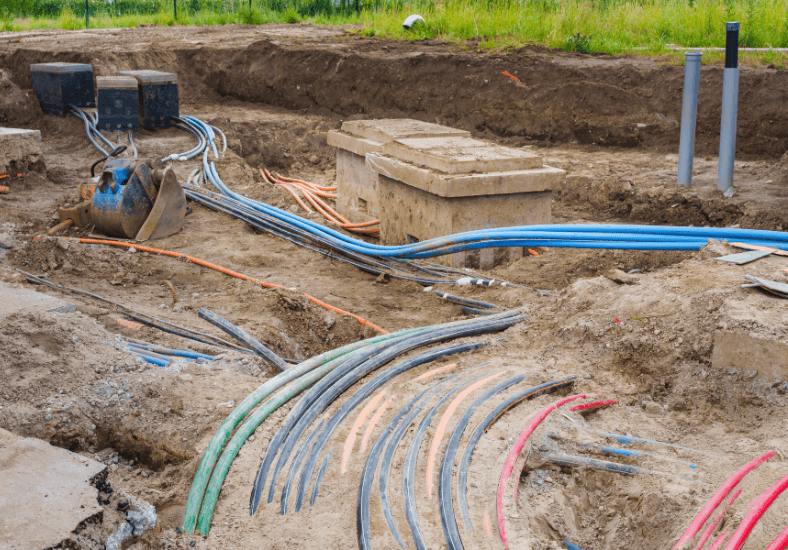
Underground utility installation involves safely routing essential services — power cabling, water mains, gas lines, and communications ducts — below ground level. This protects utilities from weather, UV exposure, and accidental damage, while also removing the visual clutter of overhead lines and surface-mounted infrastructure.
A typical project includes:
- Service design and coordination with councils, utility providers, and engineers
- Pre-dig underground service detection to identify existing buried assets
- Trenching, thrusting, or trenchless installation depending on site conditions
- Duct, conduit, and pit installation to protect and provide access to services
- Cable and pipe installation for each utility type
- Backfilling and surface reinstatement to restore the site safely and neatly
- Testing and commissioning of all services before handover
When completed correctly, underground systems support future connectivity — allowing for later upgrades to fibre, EV charging infrastructure, or new utility technologies without full re-excavation.
Benefits of Going Underground
Choosing underground over overhead installation delivers significant long-term advantages across residential, commercial, and rural sites:
Benefit | What it means in practice |
Enhanced safety | Eliminates overhead hazards, reduces risk of accidental contact with live lines, and removes trip and entanglement hazards above ground |
Improved reliability | Protected from weather events, UV degradation, and environmental damage that cause above-ground infrastructure to fail |
Better aesthetics | Removes visual clutter from poles, wires, and surface-mounted equipment — important for residential, commercial, and lifestyle developments |
Lower long-term maintenance | Correctly installed underground networks require significantly less ongoing maintenance and unplanned intervention than overhead equivalents |
Future-proofing | Properly sized ducts allow additional services — fibre, EV charging infrastructure, new utility connections — to be added later without full re-excavation |
For regions like Auckland, Franklin, and North Waikato — where growth, redevelopment, and rural infrastructure investment are ongoing — underground utilities provide the foundation for future-ready sites.
Underground Utility Installation in Rural Areas: Unique Challenges
Rural underground utility projects across Franklin and North Waikato present challenges that are qualitatively different from urban or suburban work. Understanding these early allows for better planning, more accurate budgeting, and fewer surprises during construction.
Varied and Difficult Terrain
Unlike urban environments with neatly laid out road corridors, rural landscapes can be hilly, rocky, heavily forested, or waterlogged. This diversity in ground conditions makes it harder to plan optimal service routes and can significantly affect excavation methods and costs. Thorough site surveys before project commencement are essential.
Remote Access and Logistics
Many rural sites lack direct or well-formed access routes, which complicates the delivery of plant, materials, and machinery. Without the established road networks found in urban areas, logistics planning requires more time and care. Poorly managed access can extend project timelines and increase costs substantially.
Sparse or Non-Existent Infrastructure
In rural communities, existing utility connections are often limited or entirely absent. This means the scope of work is greater — connections may need to be extended over several kilometres from the nearest grid or network infrastructure. This demands comprehensive groundwork and careful planning to ensure new installations are connected efficiently and sustainably.
Agricultural Land and Livelihoods
Farms and lifestyle blocks depend on the productive use of the land — and construction activities that cut across paddocks, orchards, or cropping land have real implications for farm operations. Coordinating carefully with landowners to minimise disruption to planting, harvesting, and stock management is essential for maintaining goodwill and keeping projects on schedule.
Every rural project we undertake at Utility Works begins with direct conversation with the property owner to understand operational constraints and plan works around the farm calendar wherever possible.
If you are setting up a live construction site rather than planning a finished network, our guide to setting up utilities on a construction site in NZ covers temporary power, building water supply, fibre lead-ins, corridor access and the order to apply for each.
Key Considerations Before You Dig
Regardless of whether your project is urban, rural, or commercial, thorough pre-dig preparation reduces risk, protects existing assets, and keeps projects compliant. These are the critical steps:
1. Identify What’s Already Underground
Never break ground without first conducting a professional underground service detection survey. Striking an existing power cable, water main, or gas line during excavation can cause serious injury, significant damage, and costly project delays. Utility Works provides full pre-dig assessments using specialist locating equipment to map existing services before any work begins.
2. Plan for Multiple Services from the Start
Modern sites typically require power, water, communications, and sometimes gas. Coordinating duct and pit installation for all services in a single trenching operation is far more cost-effective than returning to excavate for each service separately. Planning for future services at this stage — by installing spare conduits alongside active ducts — eliminates the need for disruptive re-excavation later.
3. Understand Consent and Compliance Requirements
Each region has its own requirements for excavation permits, reinstatement standards, connection approvals, and resource consents. In Auckland, this involves compliance with Vector, Watercare, and Auckland Council requirements. In Franklin and North Waikato, Waikato Regional Council and WEL Networks requirements apply. A qualified installer will know what’s required in your area and manage the approvals process on your behalf.
4. Assess Environmental and Site-Specific Risks
On rural and semi-rural sites in particular, it’s important to evaluate how the installation will affect local water courses, soil stability, native vegetation, and any areas of ecological sensitivity. This assessment informs routing decisions and helps identify where additional protective measures — such as trenchless methods over waterways — may be required.
5. Use Experienced, Qualified Installers
Underground utility work is not a project to cut corners on. Poor installation — incorrect burial depths, inadequate conduit protection, non-compliant jointing, or inadequate reinstatement — creates failures that are expensive to locate and repair, often years after the project is completed. Utility Works’ experienced crews are trained to network operator and local authority standards, and their work is backed by proper documentation and compliance records.
Technologies and Methods
Modern underground utility installation goes well beyond conventional open trenching. The right method for your project depends on site conditions, terrain, depth requirements, and the need to minimise surface disruption.
Open Trenching
The standard method for most installations. A trench is excavated to the required depth along the service route, ducting and cables or pipes are laid, and the trench is backfilled and reinstated. Most cost-effective on open ground with straightforward access.
Horizontal Thrusting
Used where digging open trenches is impractical — for example under existing driveways, pathways, waterways, or road crossings. A horizontal thrust bore is driven through the ground to create a conduit without surface excavation. Thrusting is a key method for minimising disruption on sites where access is constrained.
Trenchless Technology (Directional Drilling)
For longer or more complex crossings, horizontal directional drilling (HDD) allows conduits to be installed along a precise underground path with minimal surface disturbance. This method is particularly valuable on rural sites with sensitive terrain, near waterways, or in areas where open excavation would be impractical or environmentally damaging.
Remote Sensing and Underground Service Detection
Before any excavation begins, Utility Works uses specialist remote sensing and electromagnetic detection equipment to accurately locate and map existing buried services. This technology significantly reduces the risk of accidental damage to live assets during digging and provides critical information for routing new services safely around existing infrastructure.
Drone Surveys
For larger rural or commercial projects, drone-based aerial surveys provide rapid, highly detailed site mapping that would take significantly longer using ground-based methods. Drone surveys help assess terrain, identify obstacles, plan efficient routing, and provide baseline documentation for as-built records.
Our Underground Utility Installation Process
Every Utility Works project follows a consistent, structured process that covers all stages from initial assessment through to final handover.
- Site Assessment & Planning — We conduct a full site assessment, identifying existing services through underground detection and mapping, confirming service routing options, and coordinating with councils, utility providers, and engineers. This stage also covers consent applications and approvals where required.
- Trenching, Thrusting & Trenchless Installation — We select the most appropriate excavation method for each section of the project based on site conditions, surface constraints, and depth requirements. Open trenching, horizontal thrusting, or directional drilling are used as appropriate — or in combination on larger projects with varied terrain.
- Duct, Conduit & Pit Installation — We install the correctly specified duct types for each service — power, communications, water, gas — along with access pits where required. Spare conduits are installed where future service additions are anticipated, protecting the investment for later expansion without re-excavation.
- Utility Installation & Cabling — Power cabling, water pipes, communications cables, and gas lines are pulled through and connected to create the full operational network. Connections to network operator infrastructure and on-site building services are made at this stage.
- Testing & Commissioning — All services are tested to confirm they meet safety, performance, and compliance standards before the site is handed over. Power connections are tested with network operator sign-off, water systems are pressure tested, and comms infrastructure is verified for signal integrity.
- Reinstatement & Documentation — We restore the site surface to its original condition — whether that is turf, road pavement, gravel, or concrete. Full as-built documentation and compliance records are provided for council submission or future reference.
Common Projects We Complete
Utility Works operates across a broad range of project types, from single-property connections to large multi-service infrastructure installations.
Project Type | What’s involved |
New build utility connections | Full multi-service packages for residential or commercial sites, including power, water, comms, and gas ducting from boundary to building |
Overhead to underground conversion | Replacing existing overhead lines and poles with underground cable — improving safety, aesthetics, and long-term reliability for established properties |
Rural power & farm water installation | Complete underground infrastructure for farms and lifestyle blocks, including power to sheds, stock water reticulation, and irrigation networks |
Shed & sleep-out connections | Safe, compliant power and data connections for secondary buildings, with all ducting and cabling installed to network operator standards |
Irrigation system installation | Underground water distribution networks for agricultural, horticultural, commercial, and residential irrigation |
EV charger & arena lighting | Integrated power solutions for EV charging infrastructure, sports facilities, outdoor lighting, and other specialised load installations |
Local Expertise Across Auckland, Franklin & North Waikato
Utility Works is based in the Counties region and operates across Auckland, Pukekohe, Franklin, and North Waikato. Our team understands the practical differences between these areas — from dense urban environments with complex existing service networks, to rural and semi-rural sites with challenging terrain and limited existing infrastructure.
We coordinate closely with local authorities, network operators, and service providers — including Vector, Watercare, WEL Networks, and Waikato Regional Council — to ensure every project meets both technical and regional requirements. This local knowledge reduces consent and approval delays and ensures our installations are compliant from day one.
Whether you’re connecting a new build in South Auckland, installing multi-service infrastructure for a farm in Franklin, or developing a rural subdivision in North Waikato, Utility Works delivers professional, compliant, and long-lasting results.
Before You Dig, Contact Utility Works
Safe, compliant, and efficient underground utility installation starts with expert planning. Whether you’re preparing a new development, upgrading existing services, or tackling a complex rural infrastructure project, Utility Works provides professional end-to-end delivery across Auckland, Franklin, and North Waikato.
Contact us today to arrange a site consultation or get a detailed quote for your project.
FAQs
How do I find out what’s already buried on my site before digging?
The safest approach is to commission a professional underground service detection survey before any excavation begins. Utility Works carries out pre-dig assessments using specialist electromagnetic and ground-penetrating radar equipment to locate and map existing buried services — power, water, gas, and telecommunications. Council as-built records can also provide useful guidance, but they’re not always complete or accurate, particularly on older sites.
Can you install multiple services in a single trench at the same time?
Yes — and we strongly recommend it. Installing power, water, communications, and gas ducting in a single trenching operation is significantly more cost-effective than returning to the same route for each service separately. We also recommend installing spare conduits alongside active services at this stage, so future service additions can be made by simply pulling new cables through existing ducts without any further excavation.
Do I need council consent for underground utility installation on my property?
It depends on the type and scale of work. Connections to network operator infrastructure (power, water, telecommunications) typically require network operator approval and may require building consent for certain electrical or plumbing work. Excavation in or near road corridors requires a corridor access request. On rural sites, regional council consent may be required for works near waterways or that could affect land drainage. Utility Works handles the consent and approval process as part of our project management, so you don’t need to navigate this independently.
What is the difference between trenching and trenchless installation, and when is each used?
Open trenching involves excavating a trench along the full service route — it’s the most cost-effective method on open ground with good access. Trenchless methods — including horizontal thrusting and directional drilling — install conduits below ground without a continuous open excavation. They’re used where digging is impractical or damaging: under roads, driveways, pathways, waterways, or established landscaping. On many projects, both methods are used in different sections depending on site conditions.
How long does a typical underground utility installation project take?
Timeframes vary considerably depending on the scale and complexity of the project. A straightforward single-service connection to a residential property or shed can typically be completed in a day. A multi-service installation for a new build or small subdivision might take two to five days. Larger rural or commercial projects with extensive trenching, multiple services, and consent processes can take several weeks. We provide a clear programme and timeline at the quoting stage so you can plan your project around it.
Let's discuss your underground project needs. Contact us today for a free, no-obligation quote.
Free, no-obligation quote · Mon–Fri 7am–5pm · Auckland, Franklin & North Waikato