
Articles & Advice · 21 October 2026
How to Set Up Utilities on a Construction Site in NZ: Power, Water, Comms and Access
Every build needs power, water and a way in before the first slab is poured, and most of the delays we see on new sites come from someone ordering those three things in the wrong order or too late. This guide walks through temporary and permanent utilities for a construction site in New Zealand, who you apply to, how long each one takes, what it typically costs, and how to sequence the trenching so you dig once.
A bare section in Drury, a knock-down rebuild in Mt Eden, a shed and yard on a Waikato farm: the utilities problem is the same. The site needs power for tools and a site office, water for the concrete crew and the wash-down, somewhere for the portaloo, a way for trucks to get in without wrecking the footpath, and eventually permanent connections that the house or building will use for the next fifty years. Each of those has a different organisation behind it, its own application, its own lead time and its own rules about digging. This guide puts them in order. It is written for owner-builders, project managers and small builders in Auckland and the Waikato.
Start with what is already in the ground
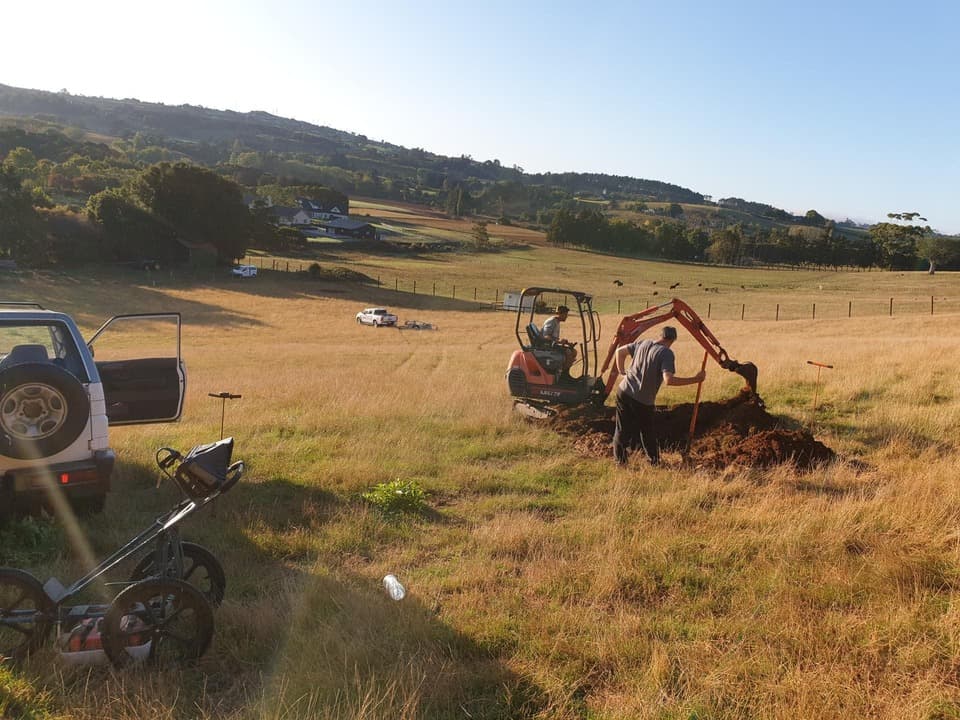
Before anything is ordered or dug, lodge a beforeUdig enquiry for the site and the berm in front of it, and book a service locate. On a bare greenfield lot the berm will hold the water main, power, fibre and possibly gas that you will be connecting to. On an infill or rebuild site the section itself will have the old laterals, the old power service, drainage and whatever a previous owner buried. Striking any of it stops the job and lands you with the repair bill. Our guide to what beforeUdig gives you and what it doesn't covers the plans and the locate; our pre-dig services investigation is the service itself. This also tells you where the connection points are, which decides where the pillar, the meter and the fibre lead-in should go.
Temporary power
Most sites run on a builder's temporary supply: a temporary switchboard on a pole or stand near the boundary, connected to the network and metered, with RCD-protected outlets for tools and the site shed. It is set up by a registered electrician, who applies to the lines company for the connection and arranges a retailer account. The lines company creates an installation control point, the ICP number that identifies the connection, and its contractor livens the board. Temporary installations on construction sites have to meet AS/NZS 3012, which covers protection, testing and tagging. Typical lead time is two to six weeks from the electrician's application, longer in summer. What you pay is the electrician's work on the board, the lines company's connection fee and the power used. If the programme cannot wait, a generator fills the gap, but at a running cost that makes the application worth lodging early.
The smarter move on many sites is to skip the temporary board and bring the permanent underground supply in at the start. The pillar goes in at the boundary during the earthworks, the permanent cable runs in duct to a temporary board positioned where the permanent switchboard will be, and when the building is up the electrician moves the connection inside. One application, one trench, one livening, and no second visit from the lines company. It needs the permanent switchboard position decided early, which is a reasonable thing to ask of a plan.
Water
Taking water from a fire hydrant without a licence is illegal in New Zealand and the fines are real. Watercare and the Waikato councils hire licensed standpipes for exactly this, metered and billed, and for a short job or a remote site that can be the simplest answer. For most builds the better route is a building supply connection: a new water connection application to the network owner, a meter installed at the boundary, and a tap or a temporary line from it. In Auckland the application goes to Watercare; elsewhere to the council's water business. Allow four to eight weeks for a standard connection where a main runs past the frontage, longer if the main is on the other side of the road and has to be crossed, and considerably longer if a main extension is needed. Connection fees are set by the supplier and, for a new dwelling in Auckland, Watercare's Infrastructure Growth Charge applies as well, currently in the order of $15,000 to $18,000 excluding GST per standard dwelling. The same meter serves the finished house, so the lateral from the meter to the building, which is yours to install, should be laid at full size and depth from the start rather than as a temporary hose that becomes permanent by neglect.
Rural sites off the town supply use a tank and a pump, filled by a water carrier or a bore. If the finished property will run on a bore, drilling it early gives the build its water and tests the yield before anyone commits to a design around it. Our rural and farm connections page covers bores, tanks and troughs.
Wastewater, stormwater and sediment
Portaloos cover the crew. The permanent wastewater connection, in Auckland to Watercare and elsewhere to the council, is applied for with the water connection and laid with it, typically in the same corridor at a different depth. Stormwater from the finished building goes to the public system or to soakage depending on the ground and the council's rules, and the connection point will be shown on the engineering drawings. During construction the thing that actually gets sites stopped is sediment. Auckland Council's erosion and sediment control guidance applies to earthworks of any size, and a silt fence, a stabilised entrance and a sump around any trench pump are the minimum before the first bucket moves.
Communications
Fibre is the default for new connections. In Auckland the network is Chorus; around Hamilton and much of the Waikato it is Tuatahi First Fibre. Both have a new-build process: you or your electrician lodge the order, the network supplies its duct specification for the lead-in from the boundary to the external termination point on the building, you install the duct during your trenching, and the network pulls the fibre and connects it once the building is closed in. A standard residential install is often free or low cost if the duct is in and to spec. Order fibre when you order power, lay the duct in the same trench with a draw wire, and leave a spare duct beside it.
Gas
Where a reticulated gas network runs past the site, the connection is arranged through a licensed gasfitter and the network company. Our part is locating the existing gas main and service before anyone digs near it and laying the gas duct in the common trench to the gasfitter's and network's specification. Gas mains carry some of the strictest exclusion zones of any service, so they are always potholed before mechanical digging nearby.
Site access and the road corridor
Trucks crossing a footpath and berm need a temporary vehicle crossing: a formed, protected ramp over the kerb and footpath so neither is destroyed and nobody trips. In Auckland that needs a vehicle crossing permit from Auckland Transport; in the districts, the council's roading team. The permanent vehicle crossing is built at the end, to the authority's standard, and it is often the last thing holding up a code compliance certificate. Any work in the road reserve, which includes digging the berm to connect to the water main or the power pillar, needs a corridor access request to the road controlling authority, lodged with a traffic management plan where traffic is affected. Allow five to fifteen working days for approval and build it into the programme, because the connections cannot be made without it. Residential frontages on quiet streets are routine; anything on an arterial is not.
Sequencing: dig once
The expensive version of a site setup is four trenches dug on four different days by four different trades, each one cutting the surface the last one reinstated. The efficient version looks like this.
- Locate and pothole everything in the berm and on the site. Mark the connection points.
- Lodge every application at once: power with the lines company, water and wastewater with the supplier, fibre with the network, the corridor access request and the vehicle crossing permit with the road authority.
- Agree the service corridor from the boundary to the building with the designer, with the pillar, the meter box and the fibre termination point fixed on the plan.
- Run one common trench during the earthworks, with each service at its required depth and separation: water and gas with their own cover, power in heavy-duty orange duct deeper again, comms duct beside it, and marker tape over each. Add a spare duct. Do this before the driveway, the retaining walls and the slab, not after.
- Connect as each approval comes through, using the same trench ends.
- Record where everything went with photos and GPS before backfill. The as-built goes to the council with the consent documents and saves the next person a locate.
On a larger project the same logic applies at a different scale: the site's reticulation for power, water and comms is planned as a network, and our guide to underground utility installation across Auckland, Franklin and North Waikato covers that end-to-end process, from design and consents through trenching, ducts and pits to commissioning.
Lead times at a glance
| Item | Apply to | Typical lead time |
|---|---|---|
| Builder's temporary power | Lines company via your electrician | 2 to 6 weeks |
| Permanent power connection (pillar, duct, cable) | Lines company via your electrician | 4 to 10 weeks |
| Water connection and meter | Watercare or council water business | 4 to 8 weeks |
| Wastewater connection | Watercare or council | With water |
| Fibre lead-in duct and connection | Chorus or Tuatahi First Fibre | 4 to 8 weeks after duct is in |
| Corridor access request | Road controlling authority | 5 to 15 working days |
| Temporary vehicle crossing permit | Auckland Transport or district council | 1 to 3 weeks |
| Service locate and potholing before any of it | Utility Works | Days |
Lead times stretch in summer and after storms. The point of the table is the first column: the applications are the critical path, not the digging. For the ground work itself the same rule applies. Leak detection and service detection jobs can start from $300 +GST. Every job is different, so call 0800 779 588 and we'll talk through your situation and give you an estimate.
Mistakes we are called in to fix
- The driveway was poured before the water lateral, power duct or fibre went in. Everything then has to be bored under it.
- The temporary hose from the meter became the permanent water supply, shallow and unprotected, and froze or got cut by the landscaper.
- Power was trenched to the boundary before the lines company confirmed the pillar position, and the pillar went somewhere else.
- The old lateral or power service from the demolished house was left live and undocumented, and the new foundations went through it.
- Nobody lodged the corridor access request, so the connections sat approved but unmade for three weeks.
- No spare duct, so the EV charger, the sleepout and the second fibre line two years later each needed their own trench.
- Services laid cheap and shallow. In September 2026 we repaired a 50 mm tee on a recent installation that had failed from side loading and misalignment; the water pipe sat directly on the electrical slab with cables in contact beneath it, no separation, no bedding in rock and everything dangerously shallow.
Where Utility Works fits
We handle the ground side of all of it: the locate and potholing before anything is dug, the common trench, the ducts and pits, the water lateral, the power duct and cable to the pillar, the fibre and gas duct, the reinstatement and the as-built record. We work alongside your electrician, drainlayer and gasfitter and with Vector, Counties Energy, WEL Networks, Watercare, Chorus and the Waikato councils regularly, so the pillar positions, depths and separations are second nature. In August 2026 the crew service-detected, hydro-slotted and dug ten test pits across a South Auckland site ahead of a major infrastructure upgrade. For a single house that is a day or two on site at the right point in the programme; for a yard, a shed complex or a multi-unit site it is a planned package. See our complete utility installation and new build utility installations pages for the detail.
If you are setting up a site anywhere from Auckland to Hamilton or across to Thames, call Utility Works on 0800 779 588 before the earthworks start. Send us the site plan and we will tell you what is in the berm, what to apply for this week and how to run one trench instead of four.
Frequently Asked Questions
How do I get temporary power on a building site in NZ?
A registered electrician installs a temporary switchboard to AS/NZS 3012 and applies to the lines company for a connection, and you open an account with a retailer. Allow two to six weeks. On many sites it is better to bring the permanent underground supply in at the start and run a temporary board off it.
Can I use a fire hydrant for water on site?
Only with a licensed standpipe hired from the water supplier, metered and paid for. Taking water from a hydrant without one is illegal. For most builds a building supply connection with a meter at the boundary is the better option and becomes the permanent supply.
How long does a new water connection take in Auckland?
Typically four to eight weeks from a complete application to Watercare where a main runs past the frontage, longer if the main has to be crossed or extended. Apply at the same time as power so the connections arrive together.
Do I need a permit to dig in the berm to connect my services?
Yes. Any work in the road reserve, including the berm and footpath, needs a corridor access request to the road controlling authority, Auckland Transport in Auckland or the district council elsewhere, with a traffic management plan where traffic is affected. Allow five to fifteen working days.
Can power, water, fibre and gas share one trench?
Yes, and they should. Each service sits at its own required depth and separation within a common trench, with marker tape over each and a spare duct for the future. One trench during earthworks is far cheaper than four trenches across a finished site.
What should go in before the driveway is poured?
Everything that crosses it: the water lateral, the power duct and cable, the fibre duct, the gas duct if any, the stormwater and wastewater connections and a spare duct. Anything left out has to be bored or cut in later at several times the cost.
Who locates the existing services before we start?
A service locating contractor such as Utility Works, working from your beforeUdig plans. We trace and mark everything in the berm and on the site, pothole the crossings, and give you a mark-out and a record before the earthworks begin. Leak detection and service detection jobs can start from $300 +GST. Every job is different, so call 0800 779 588 and we'll talk through your situation and give you an estimate.
Let's discuss your underground project needs. Contact us today for a free, no-obligation quote.
Free, no-obligation quote · Mon–Fri 7am–5pm · Auckland, Franklin & North Waikato