
Articles & Advice · 5 March 2026
Water Main Replacement Cost in NZ: Repair, Renewal or Replace?
When a water main or lateral starts leaking, the first instinct is to patch it. Sometimes that is right. Often it is the first of several patches that together cost more than a new pipe would have. This guide sets out what repair, renewal and replacement each involve, what decides the cost of each in New Zealand, how to tell which one your pipe needs, and the pipe materials around Auckland and the Waikato that are past their time, with examples from our own jobs.
"Water main" means different things to different people. To Watercare it is the pipe in the street. To a homeowner it is the pipe from the meter to the house, which the industry calls the lateral or service line. To a body corporate, a school or a farm it is the private reticulation feeding every building and trough. All of them age, all of them leak eventually, and the decision at that point is the same: fix the spot, rehabilitate the pipe or lay a new one. Utility Works does all three across Auckland, Franklin, North Waikato and the Hauraki Plains, and because we also find the leaks in the first place, we see where each choice pays off and where it does not.
The three options
Repair
A repair fixes a specific fault: a split, a failed joint, a corroded section. The pipe is exposed at the leak, the damaged length is cut out and replaced with a short piece and couplings, and the ground is reinstated. It is quick, usually done the same day the leak is pinpointed, and it is the right answer for a one-off fault on a pipe that is otherwise sound.
Renewal
Renewal rehabilitates the existing pipe without replacing it along a new route. Methods include relining, where a liner is inserted and bonded inside the old pipe; slip-lining, where a slightly smaller pipe is pushed through the old one; and pipe bursting, where a head is pulled through the old pipe, fracturing it outward while drawing a new pipe of the same or larger size in behind it. All are trenchless, needing only a pit at each end, which is why they suit pipes under roads, buildings and driveways. Renewal cannot increase capacity except by bursting, and it needs an old pipe that is straight and continuous enough to work through.
Replacement
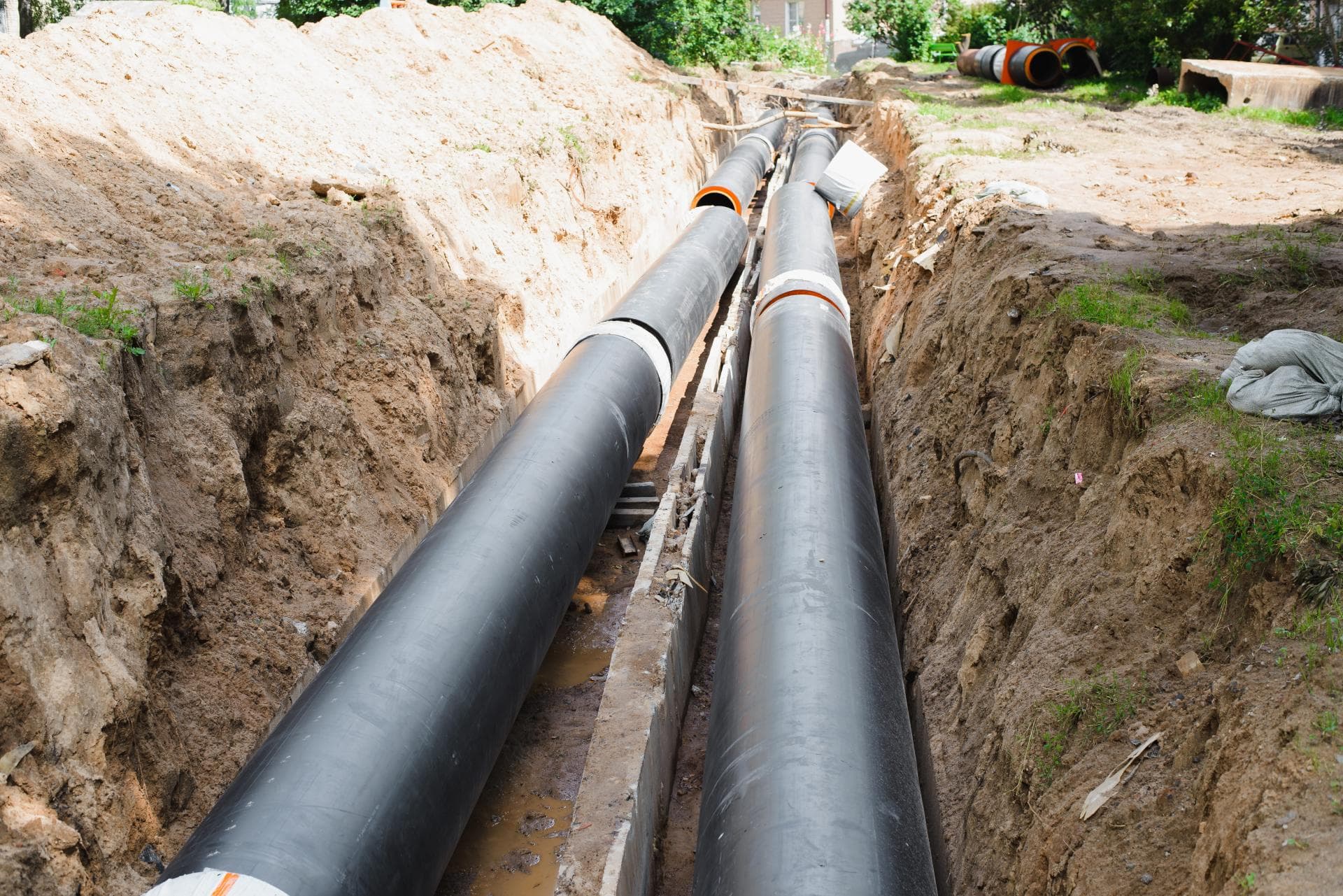
Replacement lays a new pipe, usually polyethylene, often on a new alignment, and abandons the old one in the ground. It is done by open trench where the ground is clear and by directional drilling where it is not. It resets the clock completely, lets the pipe be upsized, and lets the route be moved away from the tree roots or the slab that caused the trouble. It is the most disruptive option on the day and the cheapest over the life of the asset when the old pipe is at the end of its life.
What decides the cost of each
We quote from the site, not from a price list, because what is on top of the pipe and what the pipe is made of change the job more than its length does. Finding the fault comes first. Leak detection and service detection jobs can start from $300 +GST. Every job is different, so call 0800 779 588 and we'll talk through your situation and give you an estimate. For the work that follows, these are the things that move it.
| Work | What moves the cost up or down |
|---|---|
| Spot repair on a lateral | Depth; whether it is under lawn, gravel, paving or concrete; pipe material and the fittings needed to join to it; how much reinstatement the surface needs |
| Replace a suburban lateral, meter to house | Length; how much of the route can be trenched versus drilled under driveways and paths; reconnection at the meter (sometimes through a new manifold) and at the house; existing services to cross |
| Replace a rural lateral across paddocks | Length and pipe size; fence, race and drain crossings; trough and shed tees; rock or peat; keeping stock water running while it is done |
| Private reticulation for a body corporate, school or village | Metres of main; number of valves, meters and hydrants; staging so occupants keep water; hard surfaces; the condition of the existing network |
| Trenchless renewal of a private main | Pipe size and length; number of pits; whether the host pipe is continuous enough to line or burst |
For commercial and multi-unit sites we do not quote from a table at all. Talk to us about your site and we will scope it from the network, the operating hours and the access. For context, publicly reported costs for renewing street mains run to thousands of dollars per metre once traffic management, service crossings and road reinstatement are counted, which is why network owners reline where they can. That is their cost, not yours: the main in the street is the supplier's, and the point where your responsibility starts is covered in our guide to who owns the pipe from the street to your house.
The pipe materials that decide the answer
More than anything else, what the pipe is made of and when it was laid tells us which option makes sense. Around Auckland and the Waikato the common ones are:
- Galvanised steel laterals (pre-1960s to the early 1970s). Corrode from the inside, lose pressure as the bore closes up, and fail at threads. Repairs rarely hold for long because the next thread along is as bad. Replace.
- Copper laterals (1950s onward). Long-lived, but pinhole in acidic volcanic soils and fail at soldered joints. Repair for a one-off; replace if pinholes recur.
- Black alkathene (low-density polyethylene, 1960s to 1980s). Goes brittle with age and UV at exposed ends, splits lengthwise, and the compression fittings leak. Common on lifestyle blocks and farm lines. Repair once; replace when the second leak appears.
- Polybutylene, sold as Dux Quest and other brands from the late 1970s to the late 1980s. Known for failing without warning as the material degrades. Insurers know it too. Replace, and plan the house pipework while you are at it.
- Early PVC (1970s and 1980s). Fine when undisturbed, but brittle, and joints fail when the ground moves. Repair or renew depending on length and access.
- Asbestos cement street mains and some private mains (1950s to 1980s). Brittle, and handling requires controls. Renewal or replacement, never patching, and leave the old pipe in the ground.
- Modern PE (blue or blue-striped, 1990s onward). Fifty years or more of life if installed properly. Repair; it will almost always be a fitting, a bad installation or third-party damage, not the pipe.
When a new pipe fails: installation, not material
Modern pipe rarely fails on its own. It fails because of how it was laid. In September 2026 we repaired a 50 mm tee on a recent installation that had been fitted with so much side loading and misalignment on the pipes that the tee simply gave way. The same trench had the water pipe lying directly on top of the electrical slab with cables in contact beneath it, service separation nowhere near specification, everything buried in rock with no bedding, and all of it dangerously shallow. We repaired it with an offset junction to take the strain off the joint. That job was almost certainly won on price. If you are deciding between quotes for new pipe, the question to ask is how it will be bedded, separated and buried, not just what it costs.
How to decide: the questions we ask
- Has this pipe leaked before? A second leak on the same length within a few years means the material is failing, not the spot. Each repair from here on buys less time than the last.
- What is it made of and how old is it? Anything on the list above older than about 40 years has done its job.
- Is pressure or flow a problem? A closing bore in galvanised pipe, or a lateral sized for a 1960s household feeding a modern home with two bathrooms and irrigation, will not be fixed by any repair. Upsizing needs replacement or bursting.
- What is on top of it? A pipe under a driveway, a slab or a mature garden costs more to open each time. Directional drilling a new line along a clear route, or renewing the old one trenchlessly, avoids ever digging there again.
- Who is affected while it is off? A household can lose water for a day. A retirement village, a school or a dairy shed cannot. Staged renewal with temporary bypasses is designed around that.
- Is the route still right? If the pipe runs under the new extension or through the roots of a tree planted in 1975, moving it is part of the fix.
A rough rule we use: if a repair will cost more than a third of the replacement and the pipe is on the list above, replace. If the pipe is modern and the fault is a fitting or damage, repair. If the pipe is under something you never want to dig up and the old pipe is continuous, renew.
Why repeated repairs end up costing more
Each repair carries the fixed costs of a call-out, a locate, an excavation and a reinstatement, plus the water lost between the leak starting and someone noticing. In Auckland that water is billed for wastewater as well. Three repairs on an old galvanised lateral over four years leave you with the pipe no better than before and the fourth leak coming. A new PE lateral on the same section is done once and comes with a pipe that will outlast the house. The maths is similar at every scale; it is just larger numbers for a body corporate.
What replacement involves
- Locate. The existing lateral and every other service on the route are traced and marked, and crossings are potholed. On older sections the power, gas and comms lead-ins are rarely where the plans say.
- Route and method. Open trench across lawn and garden; directional drilling under driveways, paths and established planting. Where the old pipe is to be abandoned it is cut and capped at both ends.
- Lay. PE pipe at the correct depth on sand or fine bedding, with tracer wire so it can be found next time, and marker tape. Sizing is checked against the house's fixtures and any irrigation or troughs.
- Connect. At the meter, through a new manifold if the supplier requires one; at the house, with an isolating valve where there was none before. Backflow prevention is fitted where required.
- Test and flush. Pressure tested before backfill, then flushed and, on larger mains, disinfected.
- Reinstate and record. Lawn, gravel or concrete made good, and the route photographed and GPS-recorded for your file.
Private reticulation on larger sites follows the same steps in stages, so that one building or block at a time is on a bypass while its section is replaced, and the network ends up with the isolation valves it should have had from the start. In April 2026 we completed a water mains renewal for a South Auckland retirement village that way, right through to the landscaping and the clean-down. The design and approval side for new networks is in our guide to water reticulation for subdivisions and developments.
How Utility Works approaches it
Because our crews do the leak detection as well as the digging, the advice you get is from people who have just listened to the pipe and know how it is failing, and who will be doing the work either way. We do not have a reason to steer you to the bigger job. We carry pipe, fittings and valves on the truck, so a repair that turns out to need more can become one on the day, and we run our own diggers, directional drill and hydro excavation trucks so nothing waits on a hired machine. One of Auckland's largest shopping centres has had us on its water mains leak detection, repairs and upgrades for over eight years. The service is described on our water mains installation and replacement page, and the detection that comes first on our underground leak detection and repair page.
If a water main or lateral anywhere from Auckland to Hamilton or Thames has started leaking, or has leaked before and you suspect it will again, call Utility Works on 0800 779 588. Tell us the age of the house, what you know about the pipe and what sits on top of it, and we will tell you straight whether it is a repair, a renewal or a new pipe, and give you an estimate for each.
Frequently Asked Questions
How much does it cost to replace a water main to a house in NZ?
It depends on the length, how much of the route can be trenched rather than drilled under driveways, what has to be reconnected at the meter and the house, and what else is in the ground, so we quote from the site. Leak detection and service detection jobs can start from $300 +GST. Every job is different, so call 0800 779 588 and we'll talk through your situation and give you an estimate.
Is it cheaper to repair or replace a leaking water pipe?
A single repair is always cheaper on the day. Replacement wins when the pipe is old galvanised steel, alkathene, polybutylene or asbestos cement, when it has leaked before, or when pressure is poor, because each further repair buys less time and the leaks keep coming.
What is the difference between water main renewal and replacement?
Renewal rehabilitates the existing pipe in place by relining, slip-lining or bursting, using pits rather than a trench, and suits pipes under roads, buildings and driveways. Replacement lays a new pipe, usually on a new route, and lets you upsize and move away from whatever caused the problem.
How long does a new polyethylene water main last?
Fifty years or more when correctly bedded, jointed and installed at depth. Modern PE does not corrode, tolerates ground movement and is the standard material for both public and private mains in New Zealand. Most early failures we see on new PE are installation faults, not the pipe.
Should I replace Dux Quest or polybutylene pipe before it leaks?
If you know you have it, yes, plan to. Polybutylene from the late 1970s and 1980s degrades and fails without warning, insurers are wary of it, and a planned replacement is far cheaper than an emergency one under a slab. The buried lateral and the house pipework are usually done together.
Does Watercare replace the pipe from the street to my house?
No. Watercare and other suppliers maintain the main in the street, the connection to your boundary and the meter. The lateral from the meter outlet to your house is the property owner's to repair or replace.
Can a body corporate replace its water reticulation without cutting water to residents?
Yes, with staging. Sections are isolated and put on temporary bypass while they are replaced, usually one building or block at a time, and isolation valves are added so that future repairs affect only the section involved. Commercial and multi-unit work is scoped from the site rather than a price list; talk to us about yours.
Let's discuss your underground project needs. Contact us today for a free, no-obligation quote.
Free, no-obligation quote · Mon–Fri 7am–5pm · Auckland, Franklin & North Waikato