
Articles & Advice · 15 October 2026
Who Owns the Pipe From the Street to Your House? Point of Supply, Responsibility and Leak Remissions in NZ
When water starts pooling in the berm or the bill doubles, the first question is who has to fix it. The answer depends on which side of the point of supply the problem sits, and that line is drawn in a slightly different place on urban, rural, cross-lease and unit-title properties. This guide explains where it is, what the water supplier will and will not do, how shared pipes and tenancies work, and how to claim back some of the water a leak cost you.
Every property connected to a town water supply has a point where the public network ends and the private plumbing begins. In New Zealand that point is normally the outlet of the water meter, or the toby, the small isolation valve at the boundary, on properties without a meter. Everything on the street side belongs to the supplier. Everything on the house side belongs to the property owner, even though most of it is buried under lawn or driveway and most owners have never seen it. Knowing where that point is on your property tells you who to call, who pays, and whose water you are losing.
The public side: main, service connection and meter
The water main runs along or under the street. From the main, a short service connection runs to the boundary of each property, where it ends at the meter box. The main, the service connection, the meter box, the meter and the fittings on its supply side all belong to the water supplier. In most of the Auckland region that is Watercare. In the Waikato District it is the council's water business, which has changed hands more than once in recent years. In the Hauraki District it is the council. The supplier maintains, repairs and replaces this equipment at its cost, and if a leak is on this side of the point of supply, it is theirs to fix.
If you see water bubbling in the footpath or berm on the street side of your meter, or the meter box is constantly full of water flowing from the supply side, report it to the supplier. They will want the address and the meter number. In Auckland, Watercare attends public-side leaks as faults and does not charge the property owner.
The private side: the lateral to your house
From the meter outlet onward, the pipe is the property owner's. That includes:
- The lateral, also called the service line, from the meter to the house.
- Every branch off it to garden taps, troughs, sheds, sleepouts, pools and irrigation.
- Isolation valves, backflow devices and fittings on the private side, including the manifold tail if your supplier installed a multi-meter manifold.
- The pipework under and inside the building.
The owner is responsible for maintaining and repairing all of it. Water that leaks from the private lateral has already passed through the meter, so the owner is billed for it. In Auckland that bill has two lines: Watercare charges for the water, and its residential wastewater charge is calculated as a fixed share of metered water, so a leak that soaks into the lawn still inflates the wastewater charge. This surprises people who assume anything buried under the lawn is the council's problem. It is not.
Where exactly is the point of supply on your property
| Property type | Usual point of supply | Watch for |
|---|---|---|
| Metered urban house | Outlet side of the meter in the box near the front boundary | Meter may be in the berm or just inside the boundary; the pipe between is still yours only from the meter outlet |
| Older unmetered house | The toby at the boundary | Suppliers have been metering these; once a meter is fitted, the point moves to it |
| Infill, terrace or townhouse | Your meter on a shared manifold at the street frontage | A long private pipe may run from the manifold past other units to yours; that whole length is yours |
| Cross-lease | Each flat's meter, or a single shared meter for the site | With one meter, the shared pipe beyond it is jointly owned under the lease |
| Unit title (apartments, body corporate) | Usually a bulk meter at the boundary | All reticulation inside is common property, the body corporate's responsibility |
| Rural metered property | Meter at the road, often hundreds of metres from the house | The entire private run across the paddocks, with every trough tee, is the owner's |
| Restricted or trickle-feed rural scheme | The restrictor and meter at the boundary | Supply is a fixed daily volume into your own tank; the tank, pump and all pipe beyond are yours |
| Right-of-way or private way | Each lot's meter at the public road, or a shared main down the private way | Shares of the common pipe are set by the easement or the joint ownership of the access lot |
Suppliers set these rules in their bylaws and customer terms, and they can differ slightly between Watercare, the Waikato councils and the Hauraki District. If you are not sure, ask the supplier where your point of supply is, and read your title for any easement or cross-lease terms covering shared pipes.
Shared pipes: cross-leases, rights of way and body corporates
This is where most disputes start. Where one pipe serves several dwellings, the shared length is usually owned and paid for jointly, with the split set out in the cross-lease, the easement instrument on the title or, for a unit title, the Unit Titles Act and the body corporate rules. A leak on the shared section is everyone's problem and everyone's bill. A leak on the branch after it splits to one dwelling is that owner's alone. Finding out which it is, before the argument, is one of the most common jobs we do: we trace the pipe, pinpoint the leak and give the owners a plan and a photo showing which side of the split it sits. Our guide to water reticulation for developments and body corporates explains how private networks are set up in the first place.
Tenants and landlords
The pipe belongs to the property, so repairing it is the owner's responsibility, not the tenant's. In New Zealand tenancies the tenant usually pays for metered water use, which means a leak on the lateral can show up on the tenant's bill before the landlord knows about it. Tenants should report any sign of a leak, a jump in the bill or a wet patch, to the landlord or property manager in writing as soon as they notice it. Landlords are obliged to repair within a reasonable time, and the water lost through a fault the tenant reported promptly is generally the landlord's cost, not the tenant's. Property managers who deal with this often keep our number on file for exactly this reason.
What the supplier will and will not do
Policies vary and change, so check with your own supplier, but as a general rule:
- They will repair leaks on the main, the service connection and the meter, replace a faulty meter, and test a meter you believe is over-reading (often for a fee refunded if it is faulty).
- They will not repair anything on the private side, locate a leak on your lateral for you, or turn out to a wet lawn inside your boundary.
- They may turn your supply off at the toby in an emergency if you ask, and some will fit a meter with a leak indicator or send continuous-flow alerts from a smart meter.
- They may grant a leak remission on your bill, covered below.
Working out which side the leak is on
- Close the toby or valve at the meter. If the meter stops and the wet area dries out over the following days, the leak is on your side.
- If the meter keeps turning with the toby closed, or the wet area is on the street side of the meter box, the fault is likely the supplier's. Report it.
- If the pressure has dropped at your house and your neighbours' too, the problem is on the network.
- If the meter moves only with the toby open and everything in the house is off, the leak is somewhere on your lateral or a branch. That is a detection job.
The full meter test, and the other signs of a buried leak, are in our guide to how to find an underground water leak.
Getting some of the water back: leak remissions
Most suppliers recognise that a hidden leak is not deliberate waste and offer some relief on the bill, with conditions. Watercare's leak remission, broadly, is a one-off adjustment of part of the excess water and wastewater charge for a leak on the private side that was repaired promptly, applied for with evidence, and not claimed within a set number of years. The share remitted, the time limits and the paperwork change, so check the current policy. The Waikato and Hauraki councils have their own remission policies with similar logic. Whatever the supplier, the evidence they want is the same and it costs nothing to collect:
- Meter photos with dates showing the high reading and the normal reading after repair.
- The repair invoice from the contractor, describing the leak and the fix.
- A note of when you first noticed the problem and when it was fixed, to show you acted promptly.
Our repair invoices are written with this in mind, and we photograph the leak before and after for your file.
Insurance
Standard New Zealand house policies cover sudden damage, such as a burst pipe flooding a room, and most exclude gradual damage. Some include a hidden gradual damage benefit, typically capped at a few thousand dollars, that can contribute to locating and repairing a leak you could not have seen. Read the policy or ask the broker; the cap and the wording differ. Insurers also increasingly ask about polybutylene (Dux Quest) pipe, which fails without warning, so if your lateral or house pipework is from the late 1970s or 1980s it is worth knowing what it is made of.
How Utility Works handles the private side
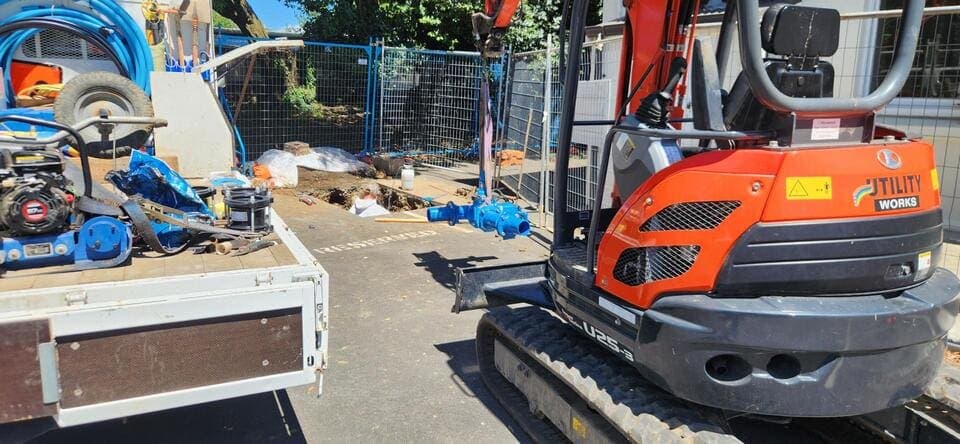
Once you know the leak is on your property, it needs to be found and fixed. Across Auckland, Franklin, North Waikato and the Hauraki Plains our underground leak detection crews trace the lateral, pinpoint the leak with acoustic equipment and tracer gas, and, because we run our own diggers and hydro excavation trucks, open the ground at that spot and repair the pipe on the same visit. Where a lateral is old galvanised steel, alkathene or polybutylene and has failed before, a spot repair is often a false economy, and we can replace the full private line from the meter to the house in one job, including the connection at the point of supply and reinstatement of the surface. That is what two buildings on one Auckland site got in September 2026, when a constantly failing old system was replaced with a new metering setup and new laterals in a single job, and it is the kind of private-side work one of Auckland's largest shopping centres has trusted us with for over eight years. The options and typical costs are in our guide to water main repair, renewal or replacement, and the service is on our water mains installation and replacement page.
If you are not sure which side of the meter your problem is on, call us on 0800 779 588 and describe what you are seeing. We will tell you honestly whether it is one for your supplier or one for us, and if it is ours, the repair is done by the same crew that finds it. Leak detection and service detection jobs can start from $300 +GST. Every job is different, so call 0800 779 588 and we'll talk through your situation and give you an estimate. The full service is on our underground leak detection and repair page.
Frequently Asked Questions
Who fixes a leak in the water meter box itself?
The meter and the fittings on the supply side of it belong to the water supplier, so a leak at the meter is normally theirs to repair at no cost to you. A leak on the outlet side, where your private pipe connects, is usually the owner's. If it is not clear which, report it to the supplier first and they will advise.
Does Watercare fix leaks on my property?
No. Watercare repairs the main, the service connection and the meter. It does not repair or locate leaks on the private lateral between the meter and the house. That is the property owner's job, and the water lost is charged to the owner, subject to any leak remission.
I rent. Is the pipe my responsibility or the landlord's?
The pipe belongs to the property, so repairing it is the owner's responsibility. Tenants usually pay for metered water, so report any sign of a leak to the landlord or property manager in writing straight away; water lost through a promptly reported fault is generally the landlord's cost.
Can I get the water I lost through a leak taken off my bill?
Often, in part. Watercare and the Waikato and Hauraki councils offer leak remissions for private-side leaks repaired promptly, usually a one-off adjustment of part of the excess charge, applied for with meter photos and the repair invoice. Conditions change, so check the current policy.
Who owns a shared water pipe on a right of way or cross-lease?
The owners it serves, jointly, in the shares set out in the easement or cross-lease on the title. A leak on the shared length is a shared cost; a leak on the branch to one dwelling is that owner's. Tracing the pipe and pinpointing the leak settles which it is.
Where is the point of supply on a rural property?
At the meter, which is usually at the road boundary and can be hundreds of metres from the house. The whole private run across the paddocks, including every trough and shed branch, is the owner's. On restricted or trickle-feed schemes the point is the restrictor at the boundary and the tank beyond it is yours.
Will my insurance cover a leaking underground pipe?
Most New Zealand house policies cover sudden damage and exclude gradual damage, but some include a hidden gradual damage benefit, typically capped at a few thousand dollars, that can help with locating and repairing a hidden leak. Check your policy wording or ask your broker.
Let's discuss your underground project needs. Contact us today for a free, no-obligation quote.
Free, no-obligation quote · Mon–Fri 7am–5pm · Auckland, Franklin & North Waikato