
Articles & Advice · 15 October 2026
How to Find an Underground Water Leak in NZ: Signs, the Meter Test and Who to Call
Most underground water leaks start small and stay out of sight. By the time water shows at the surface it may have been running for weeks, and every litre has gone through your meter. This guide covers the signs we see most often across Auckland, Franklin and the Waikato, how to run the meter test that confirms a leak, how to work out which side of the meter it is on, and who to call for each situation.
An underground leak is different from a dripping tap. The pipe is buried under lawn, driveway or a concrete slab, so there is nothing to see and often nothing to hear. The water soaks away into the ground, and the first clue is usually indirect: a bill, a meter reading, a patch of grass doing better than it should. Knowing what those clues look like, and how to confirm them in twenty minutes with your own meter, means you can act early, before the ground starts to move or the slab starts to lift.
The signs of a hidden leak
1. A water bill that has jumped without explanation
This is the sign that brings most people to us. Nothing has changed at the house, nobody has filled a pool, the irrigation has not run more than usual, yet the bill is noticeably higher than the same period last year. Compare like with like: summer against summer, winter against winter. If this winter is well above last winter, something is running that should not be. In Auckland the sting is doubled, because Watercare's residential wastewater charge is calculated as a fixed share of the water that goes through the meter, so a leak that never reaches a drain still inflates the wastewater line as well.
2. The meter keeps turning with everything off
Your water meter is the most useful leak detector you already own. It sits at the boundary, usually in a small box in the berm or footpath, and records every litre that passes the point of supply. If no water is being used on the property and the meter is still moving, water is leaving the pipe somewhere between the meter and your taps. The test is below.
3. Damp patches, unusually green grass or sinking ground
Water has to go somewhere. On the heavy clays common around Papakura, Drury, Pukekohe East and much of North Waikato it tends to pool near the surface, so you may see a boggy patch in dry weather, moss or algae on paving, or a strip of lawn that stays lush when everything around it has browned off. On free-draining ground such as Pukekohe's volcanic loam or coastal sand, the water washes fine material away and the surface drops instead. A dip in the driveway, a crack opening in a path or a small hole appearing in the lawn can all be the result of a long-running leak below.
4. A drop in water pressure
If the shower has lost its push or the hose does not reach as far as it used to, and the change has been gradual rather than sudden, water may be escaping before it reaches you. A single weeping fitting rarely drops pressure noticeably, but a split in the lateral or a failed joint can. Pressure that drops further when a second tap is opened is another pointer. Check with your neighbours first: if theirs has dropped too, the issue is on the public network rather than your property.
5. The sound of running water, or a warm patch on the floor
Stand in a quiet room at night with everything off. A faint hiss or trickle from a wall, under the floor or near where the water line enters the building is a strong sign. In houses on a concrete slab, a leak on a hot water line often shows as a patch of floor that feels warm underfoot, or as tiles that have lifted or gone hollow. Cold water leaks under a slab show as persistent damp at the base of a wall, lifting vinyl or a musty smell that does not go away.
6. A pump that will not stay off
On tank or bore supplies there is no meter, but there is a pump. If it cycles on and off through the night with nothing running, or the pressure tank never holds, water is leaving the system somewhere. Rural lines to troughs and sheds are the usual culprits.
How to run the meter test
This takes twenty minutes of your time and an hour or two of waiting, and it tells us a great deal when you ring.
- Turn off every tap, appliance and irrigation line on the property. Check toilets are not refilling and that the hot water cylinder or any header tank is not topping up. Washing machines, dishwashers and ice makers all draw water quietly.
- Lift the meter lid. Older Watercare and council meters have a row of digits plus small dials or a spinning triangle or star that acts as a leak indicator. Newer digital and smart meters show a reading and often a flow icon. Take a photo of the display and note the time.
- Watch the leak indicator for a full minute. Any movement with everything off points to a leak.
- Do not use any water for at least an hour. Two is better. Overnight is best if you can manage it, and it is the only way to catch very slow leaks.
- Take a second photo and compare. If the reading has moved, you have a leak somewhere on your side of the meter. The difference, divided by the hours, is roughly how fast it is running.
As a rule of thumb, a 1 mm hole in a pressurised pipe can lose around 20 litres an hour, close to 500 litres a day. A split joint can lose many times that. Keep the photos; they are useful evidence for a leak remission application later.
Narrowing it down: inside or outside
Most houses have an isolating valve where the water line enters the building, or at the hot water cylinder. If you can find and close it, run the meter test again.
- If the meter stops moving with the house valve closed, the leak is inside the building or at a fixture. That is a plumber's job.
- If the meter keeps moving with the house valve closed, the leak is on the buried lateral between the meter and the house, or on a branch to a garden tap, trough, shed or irrigation line. That is an underground leak detection job.
Two quick checks for inside leaks: put a few drops of food colouring in each toilet cistern and wait twenty minutes without flushing; colour in the bowl means the flush valve is passing. And look at the overflow pipe from the hot water cylinder or header tank for a steady drip.
Your side of the meter or the supplier's
The water supplier owns the main in the street, the short connection to your boundary and the meter itself. Everything from the meter outlet to your house is the property owner's. So:
- If the wet area is on the street side of the meter box, or the meter box itself is constantly full of water from the supply side, report it to your supplier. In most of Auckland that is Watercare; in the Waikato District it is the council's water provider. They will fix it at no cost to you.
- If the meter keeps turning with the toby or valve at the meter closed, the fault is on the supplier's side. Report it.
- If the meter moves only when the toby is open and the wet area is inside your boundary, it is yours to fix.
Our guide to who owns the pipe from the street to your house covers the edge cases: shared laterals, cross-leases, rural meters a long way from the house and what suppliers will and will not do.
What to do while you arrange detection
- If the leak is large, turn off the toby at the meter whenever the property is empty or overnight. It stops the loss and the bill while you organise the next step.
- Do not start digging where the ground is wettest. On clay the water often surfaces metres from the fault, and a hole in the wrong place costs labour and reinstatement and leaves the leak running.
- Gather what you know about the pipe: the age of the house, whether the lateral has ever been replaced, and any plans or photos from building work.
How an underground leak is actually found
Once the meter test has confirmed a leak on the buried line, the job is to pinpoint it without opening the whole trench. Our crews use several methods, usually in this order:
- Pipe tracing. An electromagnetic locator or a sonde maps where the lateral actually runs, which is rarely where people think.
- Acoustic listening. Ground microphones and a leak noise correlator pick up the sound of water escaping under pressure and narrow it to a spot the size of a dinner plate. Metal pipe is quick; plastic pipe takes longer. See our acoustic leak detection page.
- Tracer gas. On quiet plastic lines or deep pipe, a harmless hydrogen and nitrogen mix is introduced to the drained pipe and detected at the surface where it escapes.
- Thermal imaging. For hot water lines under a slab, the camera shows the warm plume.
- Sectional isolation. On long rural runs, the line is shut off in sections and each one pressure tested until the losing section is found.
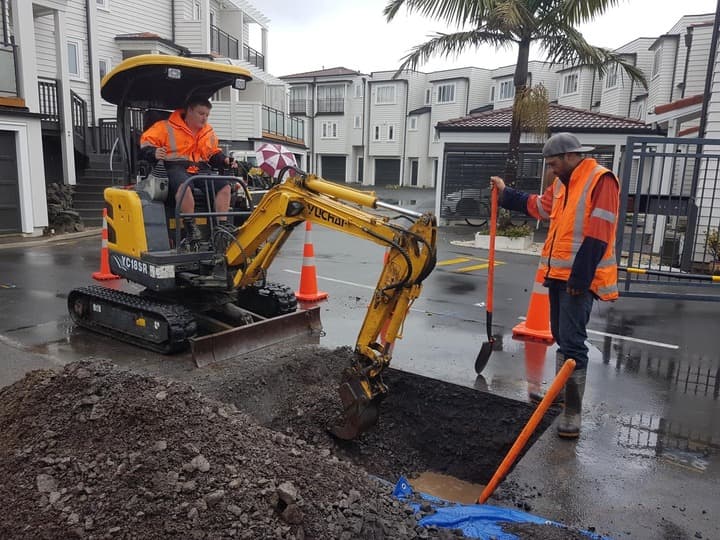
The mark on the ground is then opened by the same crew. Because Utility Works runs its own diggers and hydro excavation trucks and carries pipe and fittings, the leak is usually exposed and repaired on the same visit, with the lawn or concrete reinstated afterwards. Where the lateral is old polybutylene, black alkathene or galvanised steel and has failed before, we will tell you honestly whether a spot repair or a full replacement is the better money. Typical prices for each stage are in our guide to what leak detection costs in NZ.
Two jobs show what that looks like in practice. In May 2025 a ten-acre rural site was losing water somewhere across its network; the crew traced the line, marked one spot and dug one hole, and the leak was on the mark. In September 2026 one of Auckland's most critical operations called us after other contractors had spent months hunting a leak; with aerial infrared, ground penetrating radar and acoustic equipment used together, we traced the pipeline, pinpointed the leak, excavated, repaired and reinstated it within days of being commissioned.
Preventing the next one
Some leaks are simply age. Galvanised laterals from the 1950s and 1960s, black alkathene from the 1970s and polybutylene from the 1980s are all past their design life and will fail somewhere eventually. Beyond replacing those when they start to go, the useful habits are simple: read your meter at the start of each month and keep a note, know where your toby is and check it turns, keep heavy vehicles off the line where you can, and have any new pipe laid by someone who buries it to depth and records where it went. Smart meters, which Watercare has been rolling out, can flag continuous flow for you, so it pays to opt in to the alerts where they are offered.
Who to call
- Street side of the meter wet, or meter turning with the toby closed: your water supplier.
- Meter stops when the house valve is closed: a plumber, for a leak inside the house or at a fixture.
- Meter keeps turning with the house valve closed, or the leak is under a slab, driveway or long rural line: an underground leak detection specialist.
Across Auckland, Franklin, North Waikato and the Hauraki Plains, that specialist is us. Call Utility Works on 0800 779 588 with your meter test result and we will tell you straight away whether it sounds like one for your supplier, your plumber or our crew. Leak detection and service detection jobs can start from $300 +GST. Every job is different, so call 0800 779 588 and we'll talk through your situation and give you an estimate. Because we find and fix with one team, the leak is not left running while you wait between trades. The full service is on our underground leak detection and repair page.
Frequently Asked Questions
How do I know if the leak is my responsibility or the water supplier's?
The supplier looks after the main in the street, the connection to your boundary and the meter. Everything from the meter outlet to your house, including the pipe under your lawn or driveway, is the property owner's to maintain. If the wet area is on the street side of the meter or the meter turns with the toby closed, report it to the supplier.
Can a leak exist if my meter is not moving?
Very small leaks can run slowly enough that a one-hour test does not show them. Leave the test overnight for a clearer result. Leaks on a bore or tank supply, or on a line before the meter, will not register on the meter at all.
How much water does a small leak waste?
A 1 mm hole in a pressurised pipe loses roughly 20 litres an hour, close to 500 litres a day or around 15,000 litres a month. A split joint or a crack in an old lateral can lose several times that, and all of it is metered and, in Auckland, charged for wastewater as well.
Will finding the leak mean digging up my driveway?
Usually not. We locate the leak to a small area first using acoustic equipment and tracer gas, then open only that spot. Where a leak sits under concrete we can core a small opening or use hydro excavation rather than breaking out a large section.
Can I get the water I lost taken off my bill?
Watercare and some other suppliers offer a one-off leak remission on part of the excess charge if the leak was on your side of the meter and you repaired it promptly with proof. Conditions change, so check with your supplier and keep your meter photos and repair invoice.
Should I call a plumber or a leak detection company?
If you can see where the water is coming from, or the meter stops when the valve into the house is closed, call a plumber. If the meter keeps running with the house isolated, or the leak is under a slab, a driveway or a long rural line, call a leak detection specialist first so only one hole gets dug. Our guide to plumber versus leak detection specialist goes through it in detail.
How quickly should I act on a suspected leak?
The same week. A leak rarely gets smaller, the metered loss adds up daily, and on clay or under a slab the ground damage grows with time. If it is large, close the toby overnight while you arrange detection.
Let's discuss your underground project needs. Contact us today for a free, no-obligation quote.
Free, no-obligation quote · Mon–Fri 7am–5pm · Auckland, Franklin & North Waikato