
Articles & Advice · 15 October 2026
What Leak Detection Costs in NZ: What Affects the Price and Why One Crew Is Cheaper
People ring us wanting a price before anyone has seen the site, and that is fair. This guide gives you our straight answer on where leak detection starts, explains what makes one job take longer than another, and shows with real jobs why finding and fixing the leak with one crew usually costs less overall than hiring a detection company and then a separate digger or plumber.
Leak detection is a diagnostic service. You are paying for trained people and specialist equipment to find a fault that is hidden under lawn, concrete or a slab, and the time that takes depends on the site in front of them. Two properties with the same size leak can take very different amounts of effort to pinpoint. So here is the honest answer up front. Leak detection and service detection jobs can start from $300 +GST. Every job is different, so call 0800 779 588 and we'll talk through your situation and give you an estimate. The rest of this guide explains what sits behind that number, so you know what you are being quoted for and how to keep it down.
Why there is no rate card
A leak on a 1960s galvanised lateral under a Papakura lawn is usually found within the hour. The same size leak on a plastic line under a concrete driveway in Pukekohe, or somewhere on 400 metres of farm pipe near Te Kauwhata, is a different afternoon. We could publish a price list with twenty rows and it would still not tell you which row you are in. What we can do is tell you where jobs start, ask you a few questions on the phone, and give you a realistic estimate before anyone turns up. If the job then needs excavation and repair, you will know that price before we open the ground.
What makes one job take longer than another
Site size and the length of pipe involved
A standard suburban section with a short run from meter to house is the simplest case. There is one line, one meter and a limited area to cover. A lifestyle block with several hundred metres of pipe feeding troughs, a shed and a dwelling is a different job, and a commercial site or body corporate with a reticulated network and multiple branches is different again. The more pipe there is, the more sections we have to isolate and test before we can narrow down where the water is going. On large sites we often start with a water network survey that works through the system methodically, rather than trying to pinpoint straight away.
Pipe material
Metal pipe carries the sound of a leak well, which makes acoustic detection fast. Galvanised steel and copper laterals on older Auckland houses are often found quickly. Plastic dampens the sound. Black alkathene from the 1960s to 1980s, polybutylene (the Dux Quest era pipe many Auckland and Franklin homes still have), PVC and modern PE all take longer to hear and may need tracer gas or a correlator instead of a ground microphone. We cover this in more depth in how acoustic leak detection works on plastic versus metal pipes.
Depth, surface and access
What covers the line matters as much as the line itself.
- Open lawn or garden is the easiest surface to listen through, to open and to reinstate.
- Concrete driveways, paving and slabs muffle the sound, slow both detection and excavation, and need more care to open and make good.
- Pipes under buildings, decks, retaining walls or established trees need more planning and sometimes a different approach altogether.
- Deep pipes are harder to hear and harder to expose. Rural lines are often laid deeper than suburban ones, and the deepest leak we chased this year was well below anything a shovel would reach.
- Sites that cannot be shut off, such as a business that must keep trading or a retirement village, need the work staged around operating hours.
Soil and water table
Leaks behave differently in different ground. On the heavy clays around Papakura, Drury and much of Franklin, water travels along the old trench backfill and surfaces metres from the fault, so a wet patch is a clue rather than an answer. Pukekohe's free-draining volcanic loam can swallow a leak with no surface sign at all. Peat and high groundwater on the Hauraki Plains and around Te Kauwhata mask the sound. None of this stops detection, but it affects how long it takes.
A pinpoint or a survey
These are two different tasks. A pinpoint is where you already know there is a leak, you have a fair idea which line it is on, and you want the exact spot marked so it can be dug and fixed. A survey is where water is being lost somewhere on a larger network and the whole system needs checking, with each leak found and recorded. Surveys take longer, cover more ground and produce a report; they are usually for commercial, rural or body corporate sites. For commercial work we do not quote a number until we have talked through the site, because the network, the operating hours and the access decide the job.
Urgency and travel
A same-day call-out to a running main takes a crew off the planned run. We cover a wide area, from Auckland's North Shore to Hamilton and across to Thames, and we route jobs by area to keep travel out of your price where we can. Booking ahead and being flexible on the day both help.
Whether repair is included: the biggest variable
This is the thing to ask about before you book anyone. Some detection companies locate the leak, mark the ground and leave. You then engage a second contractor to dig and repair, and sometimes a third to reinstate. Every handover adds a call-out fee, travel and the risk that the second crew cannot find exactly what the first one meant by the paint mark.
Utility Works runs its own diggers and hydro excavation trucks and carries pipe and fittings on the truck. The people who find the leak are the same people who expose it and fix it. In practice that means:
- One site visit instead of two or three, so one call-out and one lot of travel.
- The crew that heard the leak is the one digging. They know how confident they are in the mark and how big the hole needs to be, so there is less over-digging and less reinstatement.
- No gap between finding and fixing. The leak is not left running for days while you organise the next trade, and every day it runs is metered water you pay for.
- One invoice, one point of contact, and one company responsible for the outcome.
In our experience this is why detection and repair with a single crew usually costs less overall than engaging a detection specialist and a separate plumber or digger operator, even when the detection fee alone looks cheaper elsewhere. Our leak excavation and repair page explains how the repair side works.
Three jobs that show where the money goes
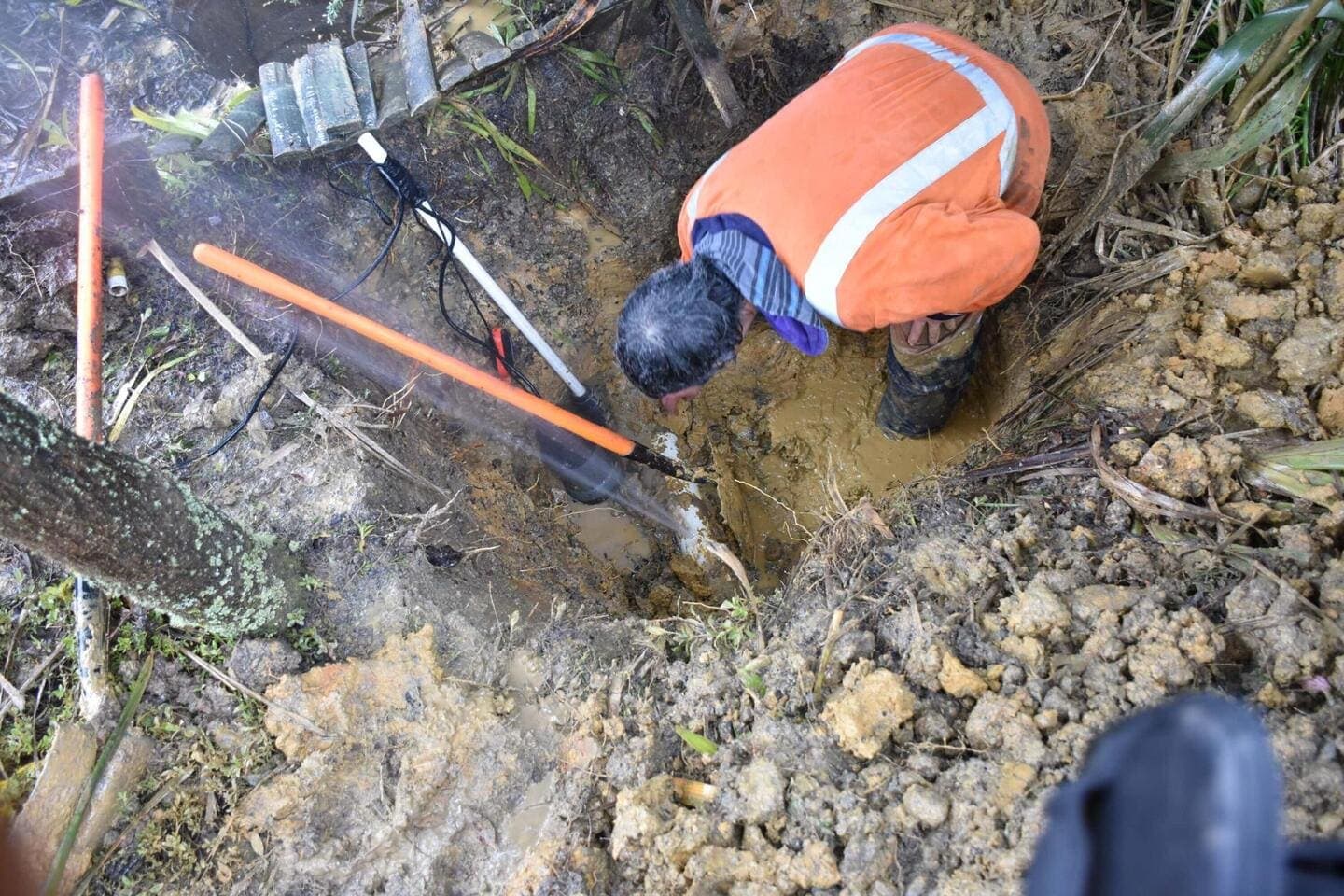
A 10 acre site, one hole. In May 2025 we were called to a large rural property losing water somewhere across ten acres of pipe. The crew traced the line, listened, marked one spot and dug one hole. The leak was on the mark. The alternative, which the owner had been considering, was trenching along the whole run until the water showed. Detection cost a fraction of that and the ground was back together the same day.
Months of other contractors, days for us. In September 2026 one of Auckland's most critical operations called us after other contractors had spent months trying to find a leak on the site. Using aerial infrared, ground penetrating radar and acoustic equipment together, and a crew that has done this for years, we traced the pipeline, pinpointed the leak, excavated and repaired it, and reinstated the ground within days of being commissioned. The cheapest detection quote is not always the cheapest leak.
Eight years with one shopping centre. In November 2025 we excavated and repaired another water leak for one of Auckland's largest shopping centres, bedded the repair with fines, cast a thrust block, compacted, landscaped and water-blasted the roadway down afterwards. We have been looking after that site's water mains leak detection, repairs and upgrades for over eight years. Commercial sites like this are not priced from a table; they are priced from knowing the network.
Is detection ever a waste of money?
Occasionally. If the wet spot is directly over a shallow pipe in soft lawn and the house is on galvanised steel, a plumber may simply dig there and find it. If the leak is inside the house or at a fixture, you need a plumber, not us, and we will tell you that on the phone. Our guide to whether to call a plumber or a leak detection specialist sets out how to decide. For anything buried, under a slab, on plastic pipe or on a long run, detection first is almost always the cheaper path.
How to keep the cost down
A few things on your end make a real difference to the time we spend on site.
- Run a meter test first and tell us the result. It confirms there is a leak and tells us roughly how fast it is running. The steps are in our guide to finding an underground water leak.
- Tell us what you know about the pipe: when the house was built, whether the line has been replaced, what it is made of and where you think it runs.
- Have any site or service plans ready, even hand-drawn ones or an old builder's sketch.
- Clear access to the meter, the toby and the likely pipe route, and tell us about anything buried we should avoid, such as irrigation or a bore line.
- Give us a window when the water can be turned off without disrupting the household or the business.
- Check whether the wet area is on the street side of the meter. If it is, the fault is probably the supplier's and costs you nothing. See who owns the pipe from the street to your house.
Will any of it come back to you?
Two places to look. Watercare and some other suppliers offer a one-off leak remission on part of the excess water and wastewater charge if the leak was on your side of the meter and you repaired it promptly with proof, so keep your meter photos and our invoice. And some New Zealand house policies include a hidden gradual damage or trace-and-access benefit, usually capped at a few thousand dollars, which can contribute to locating and repairing a leak you could not have seen. Policies differ, so check yours; our written report with photos is the evidence insurers ask for.
Getting a number for your job
Leak detection and service detection jobs can start from $300 +GST. Every job is different, so call 0800 779 588 and we'll talk through your situation and give you an estimate. We will ask about the signs you are seeing, the meter test, the age of the house and the surface over the pipe, and from that we can usually tell you what is involved before anyone turns up. If the job then needs excavation and repair, the same crew does it, and you will know the price before we open the ground. The full service is described on our underground leak detection and repair page.
Frequently Asked Questions
How much does leak detection cost in Auckland?
Leak detection and service detection jobs can start from $300 +GST. Every job is different, so call 0800 779 588 and we'll talk through your situation and give you an estimate. Pipe material, depth, what is on top of the line and whether you need a pinpoint or a whole-network survey are what change it.
Why can't you give me a fixed price over the phone?
Because the time involved depends on the site. Pipe length, material, depth, what is on top of it and whether you need a survey or a pinpoint all change the job. We can give you a realistic estimate once we have asked a few questions, and a firm figure once we have seen the site.
Is it cheaper to just dig where I think the leak is?
Occasionally, if the wet spot is directly over a shallow fault in soft ground. More often the water surfaces some distance from where it is escaping, especially on clay, and exploratory digging ends up costing more in labour and reinstatement than detection would have. Pinpointing first means one hole in the right place.
Does the detection fee get credited if you do the repair?
Every job is quoted on its own, but because the same crew does both there is no second call-out, no travel for a second trade and no handover, and that is where the saving comes from. Ask us when you call and we'll explain how your job would be priced.
How is commercial leak detection priced?
We do not quote commercial work from a table. The size of the network, operating hours, access and whether you need a one-off pinpoint or an ongoing survey programme all decide it. Talk to us about your site and we will scope it properly.
Will my insurance pay for leak detection?
Some New Zealand house policies include a hidden gradual damage or trace-and-access benefit, usually capped at a few thousand dollars, and most cover sudden damage caused by a burst pipe. Policies differ, so check yours. We provide a written report with photos that insurers accept as evidence of where the leak was and what was done.
How long does a leak detection visit take?
A straightforward suburban pinpoint is typically one to two hours on site. Slab leaks, long rural lines and plastic pipe can take half a day. A commercial network survey is usually a full day or more depending on the number of buildings and branches.
Let's discuss your underground project needs. Contact us today for a free, no-obligation quote.
Free, no-obligation quote · Mon–Fri 7am–5pm · Auckland, Franklin & North Waikato