
Articles & Advice · 23 October 2026
How to Choose an Underground Utility Detection Company in Auckland
Hiring someone to find what’s buried before you dig? “Underground detection” isn’t a regulated trade, so the gap between a specialist and someone with one hired tool is wide. Here are the seven things that actually separate them — the same checklist whether you’re a homeowner, a builder or a plumber looking for a subcontractor.
To choose an underground utility detection company in Auckland, look for one that owns its locating equipment rather than hiring it in, employs certified locators, uses more than one detection method, and can dig and repair — not just paint a line on the ground. Local knowledge of the soils and networks, public liability cover and a written record of what was found round out the list.
“Underground detection” isn’t a protected trade in New Zealand. Anyone who buys a cable locator can put it in a van and call themselves a locator, which is why the quality of the work varies so much — and why a cheap locate that misses a service can turn into the most expensive part of a job. A single strike on a live power cable or a fibre trunk line costs far more than getting the locate right the first time.
Here are the seven things that actually separate a specialist from someone with one tool and a ute.
1. Do they own their equipment, or hire it in?
A company that owns its ground penetrating radar, electromagnetic locators, hydro-vac truck and drain cameras runs that gear every working day and knows exactly what each one can and can’t see. An operator who hires a locator for the odd job is learning on yours.
This is also where a lot of people get caught out. Plenty of plumbers, drainlayers and builders don’t own this kind of equipment — and they’re sensible not to, because it only pays for itself if you’re using it constantly. So they bring in a specialist, often us, and handle it through their own invoice. That’s a perfectly good way to work: plumbers and other trades call us for exactly this. The thing to check is simply that whoever turns up — direct or through your plumber — actually owns and runs the kit, rather than subcontracting it on again.
2. Are the people doing the work certified?
The credential that means something here is NZ Certified Locator certification. It’s proof the operator has been trained and assessed, not just handed a machine. Ask whether the crew actually hold it. Our service location and detection work is done by certified locators, which is part of why network operators and councils are comfortable having us on their assets.
3. Do they use more than one detection method?
No single tool finds everything underground. Electromagnetic locators trace metallic and live services; ground penetrating radar finds plastic pipes, voids and tanks that EM can’t see; hydro-vac potholing physically exposes a service to confirm its exact depth; and CCTV drain cameras trace and inspect drains from the inside. A company with only one of these will quietly miss whatever that tool can’t detect. A specialist reaches for the right method — or combines a few — for the ground in front of them.
4. Can they dig and repair, or only mark the ground?
Many detection-only outfits hand you a marked-up footpath and drive away. Then you’re finding a digger operator, and after that someone to do the repair — three bookings, three invoices, and each one able to blame the last if something goes wrong. A company that locates, exposes and repairs with its own crew closes that gap: the people who found the problem are the people who fix it, with nothing lost between the paint line and the hole.
5. Do they know the local ground and networks?
Auckland’s clay, Franklin’s loam and the Waikato’s river flats all read differently on radar, and each council and network owner has its own process for working near their assets. A local crew knows the ground, knows how to pull the right asset plans through beforeUdig, and has usually seen whatever oddity is under your site before.
6. Are they insured, and do you get a record?
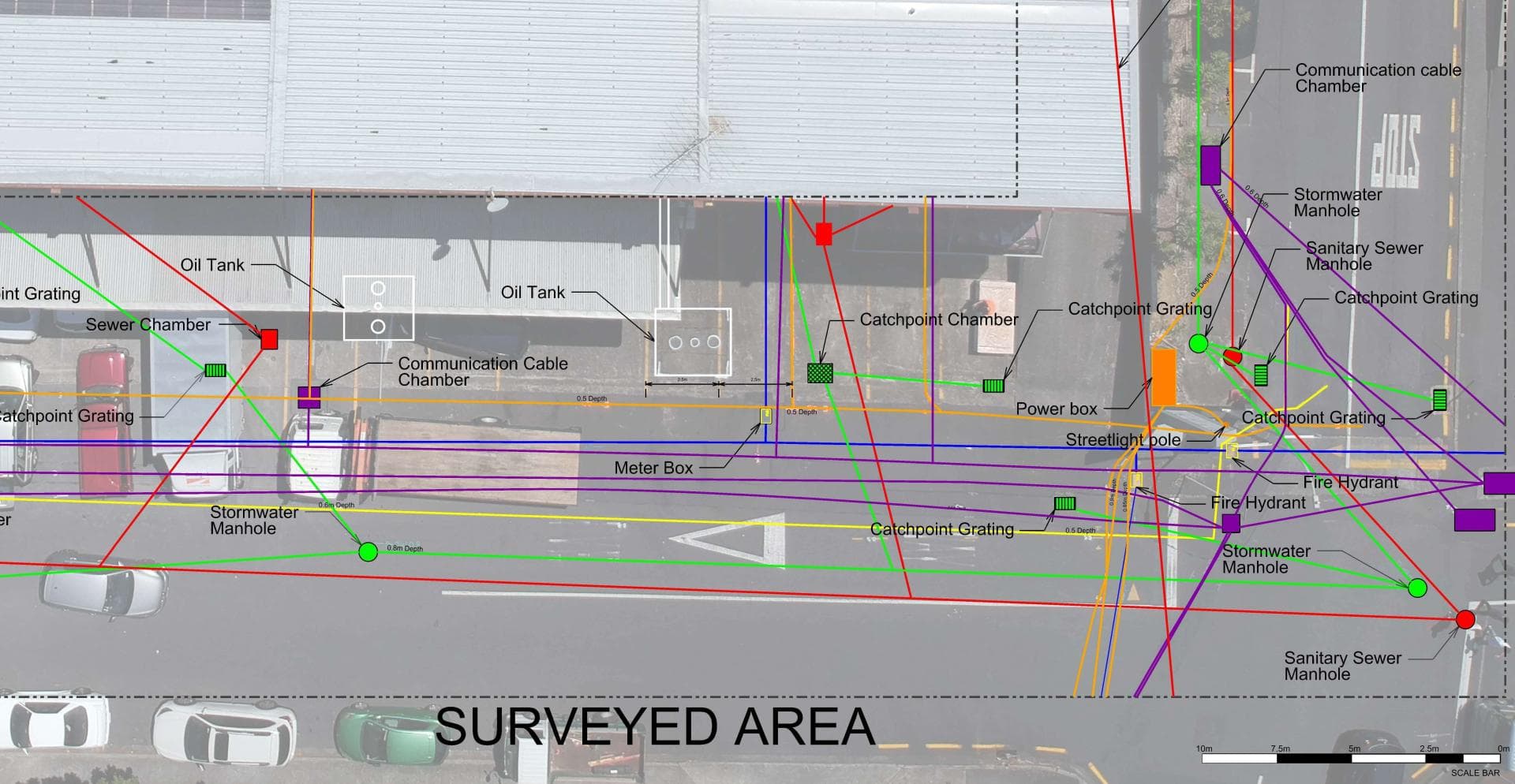
Check they carry public liability cover before anyone works near live services on your property. And ask what you’re left with at the end — a good locate gives you a marked plan or a survey-grade map of what’s there, for your consent file, your asset register or the next contractor, not just spray paint that washes off in a week.
7. Can they show you real local work?
Finally, ask for examples and reviews from jobs like yours in your area. Specialists can point to real sites — subdivisions, farms, commercial premises, old properties with no plans — not just stock photos and promises.
The same checklist works whether you’re a homeowner, a builder or a plumber
If you’re a property owner weighing up whether to call your plumber or a specialist, these seven points are how you tell them apart. If you’re a trade who needs a locate or a dig done properly under your own job, they’re how you pick a subcontractor who won’t land you with a strike.
Utility Works has worked across Auckland, Franklin and North Waikato since 2015 with our own locators, hydro-vac trucks and diggers — certified crew, the full range of methods, and one team from the first locate to the finished repair. If that’s the kind of company you’re after, call us on 0800 779 588.
Frequently Asked Questions
What’s the difference between a plumber and an underground utility detection company?
A plumber installs and repairs the plumbing; an underground utility detection company locates and maps what’s buried — power, water, gas, comms and drains — with specialist equipment before anyone digs. The two often work together: many plumbers bring in a detection specialist to locate services so they can work safely.
Is “underground detection” a regulated trade in New Zealand?
No. The label isn’t restricted, so anyone with a cable locator can use it. The credential that carries weight is NZ Certified Locator certification, and the practical test is whether the company owns the full range of detection equipment and can show real past work.
Can one company both find the problem and fix it?
Yes. Utility Works locates the service, exposes it with hydro-vac and repairs it with its own crew, so there’s no handover between separate contractors — and no one to point the finger if something goes wrong.
How much does underground service detection cost in Auckland?
It depends on the size of the site and how many services and methods the job needs — a single residential locate is a small job; a full site survey is larger. Using one crew that both locates and digs usually works out cheaper than coordinating separate outfits. Here’s what affects the price.
Do you cover Auckland, Franklin and the Waikato?
Yes. We’re based at Waiau Pa and work across Auckland, Franklin and North Waikato — including Pukekohe, Papakura, Waiuku, Tuakau, Pōkeno, Mercer and Huntly. Call 0800 779 588 to check availability for your site.
Let's discuss your underground project needs. Contact us today for a free, no-obligation quote.
Free, no-obligation quote · Mon–Fri 7am–5pm · Auckland, Franklin & North Waikato